NCAA Scouting Series: Jesse Legree, Tracking Speed And Consistency
Using tracking data to analyze an exceptional talent
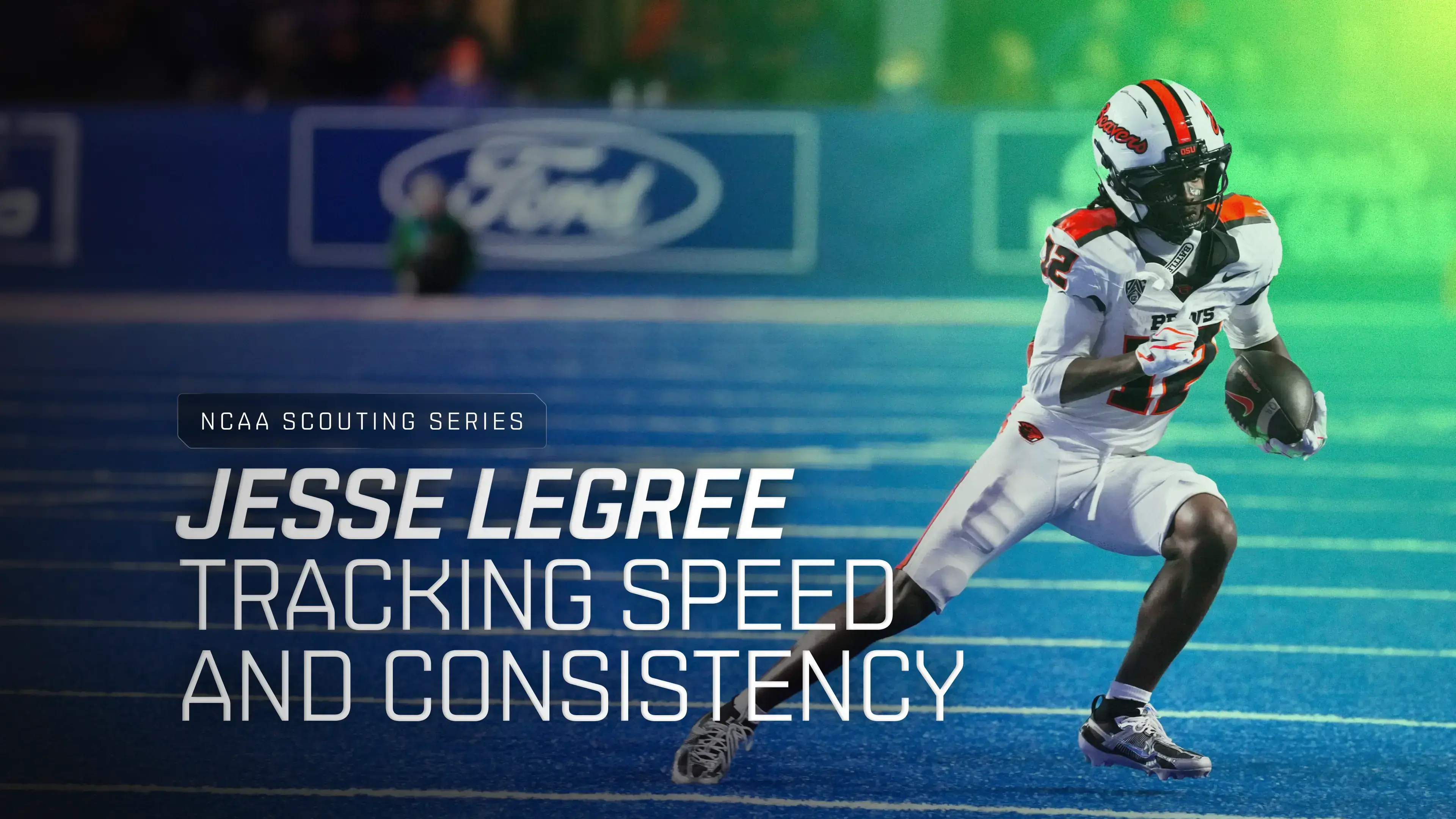
From No Offers To The Nation’s Leading Receiver
On signing day, Jesse Legree had no official offers from programs. He was rated as a three-star receiver and most recruiting boards had already moved on from the St. Frances alum.
Nine games later, the Oregon State freshman leads the FBS with 1,209 receiving yards, nine ahead of Jeremiah Smith, and is tied for the lead with 14 touchdowns. He has everyone’s attention. The question is no longer “who is this freshman?” but “Is he on a hot streak or is the breakout the real deal?”.
Our solution is built to answer these kinds of questions. We’ve tracked every one of Legree’s movements across his first nine games from All-22 video, and the data goes well beyond the box score.
Tracking Speed And Consistency Thanks To SkillCorner
So far, Legree has topped 20 mph in every game he’s played. His fastest run came against UTEP, where he peaked at 21.3 mph. Even in his “slowest” game, he still has a recorded speed of 20.2 mph. Even on a bad day, he is faster than almost every other player at their best.
To understand whether Legree was having a hot streak or simply built differently, we used a sample size of 412 FBS wide receivers with 10+ catches, across 2,362 player-games and set that against Legree’s numbers.

The main takeaway is consistency. Only three FBS receivers with 3+ games have topped 20 mph in every one: Legree (7/7), Jeremiah Smith (6/6) and Charlie Becker (5/5). By comparison, Malachi Toney did it once in six.
His top-end speed is just as steady: he is one of the only six FBS receivers with 3+ games to run a flying 10 under 1.05 s in every game.
Highlight reels show a player’s best rep. Our tracking shows every rep. This gives a far more complete reading of his profile. After all, top speed matters less than whether a player gets there every week.
Understanding How Productive His Speed Is
Speed only matters if it turns into yards, and Legree’s does.
Smith and Toney catch more than expected. Legree turns his catches into more yards after the catch than almost any receiver in the country. That’s the kind of nuance tracking data provides: it tells a coaching staff how to use a player, not just whether to recruit him or not.
Eleven seasons of context
SkillCorner’s college tracking goes back to 2016, so we can benchmark a player against a decade of real performances. Putting Legree's start in historical context, we can see that his 932 yards through six games are the biggest start to a college career in that span. For comparison, Jeremiah Smith had 573 yards and Tre Harris 368 over their first six games. The only six-game stretches that matched or beat Legree’s total came from upperclassmen mid-career.
In Practice: Tracking The Defining Touchdown
Midway through the second quarter against Texas Tech, Legree ran a play that defined his profile.
He plants for a sharp 117° break. Only 42% of receivers come out of a cut this sharp faster than they went in. The break is long, 2.7 seconds, slower than 98% of comparable cuts, but he builds speed through it, gaining more than what 90% of receivers do. He starts at 11.7 and ends the cut at 17.6 mph. That leaves him 7.3 yards clear of the nearest defender. He catches the ball 38 yards downfield, runs 37 more, and peaks at 20.2 mph on the way to the end zone.
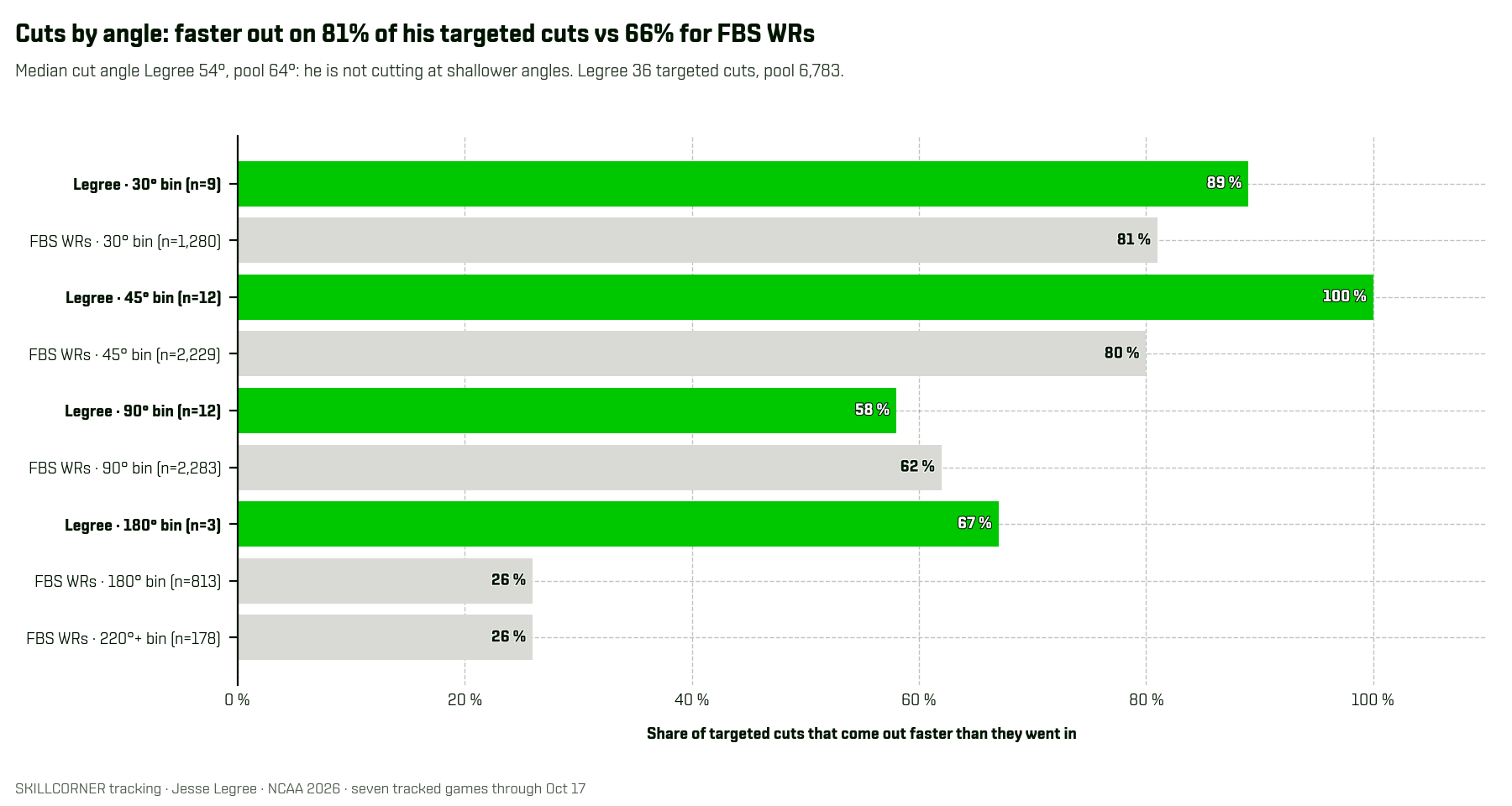
It’s a phenomenal highlight reel. Add the tracking data to it and suddenly you are identifying a pattern: Legree comes out of cuts faster than he goes into them on 81% of his targeted cuts, compared with 66% league-wide.