

How the Last Five World Cup Finals Unfolded: An Interactive Explorer
.
Analysis of past World Cup finals often plateaus at basic event-based metrics — possession share, shots on target, and distance covered - due to limitations in the data available. That lens misses most of what actually happens on the pitch: the movement, positioning, and tactical decisions that shape a match long before the ball arrives.
Ahead of this weekend's 2026 World Cup final, SkillCorner is opening up its Dynamic Events data — the combination of tracking and event data that power our Game Intelligence product — across the previous five World Cup finals, from 2006 to 2022, through an interactive explorer built for anyone interested in unpacking these historic matches with the depth of modern football data.
Our Dynamic Events Explorer lets you move beyond ordinary stats and into the often unnoticed actions that shape play: off-ball runs, on-ball engagements, passing options, and player possessions (for more details, refer to Dynamic Event definitions) in different phases, all broken down by their subtypes and visible on a pitch map.
The Explorer isn't limited to pitch maps, though. In Summary Tables, you can sort every player by any metric or subtype across a full match — surfacing, for instance, who led each team in carries at speed, runs in behind, or counter presses.
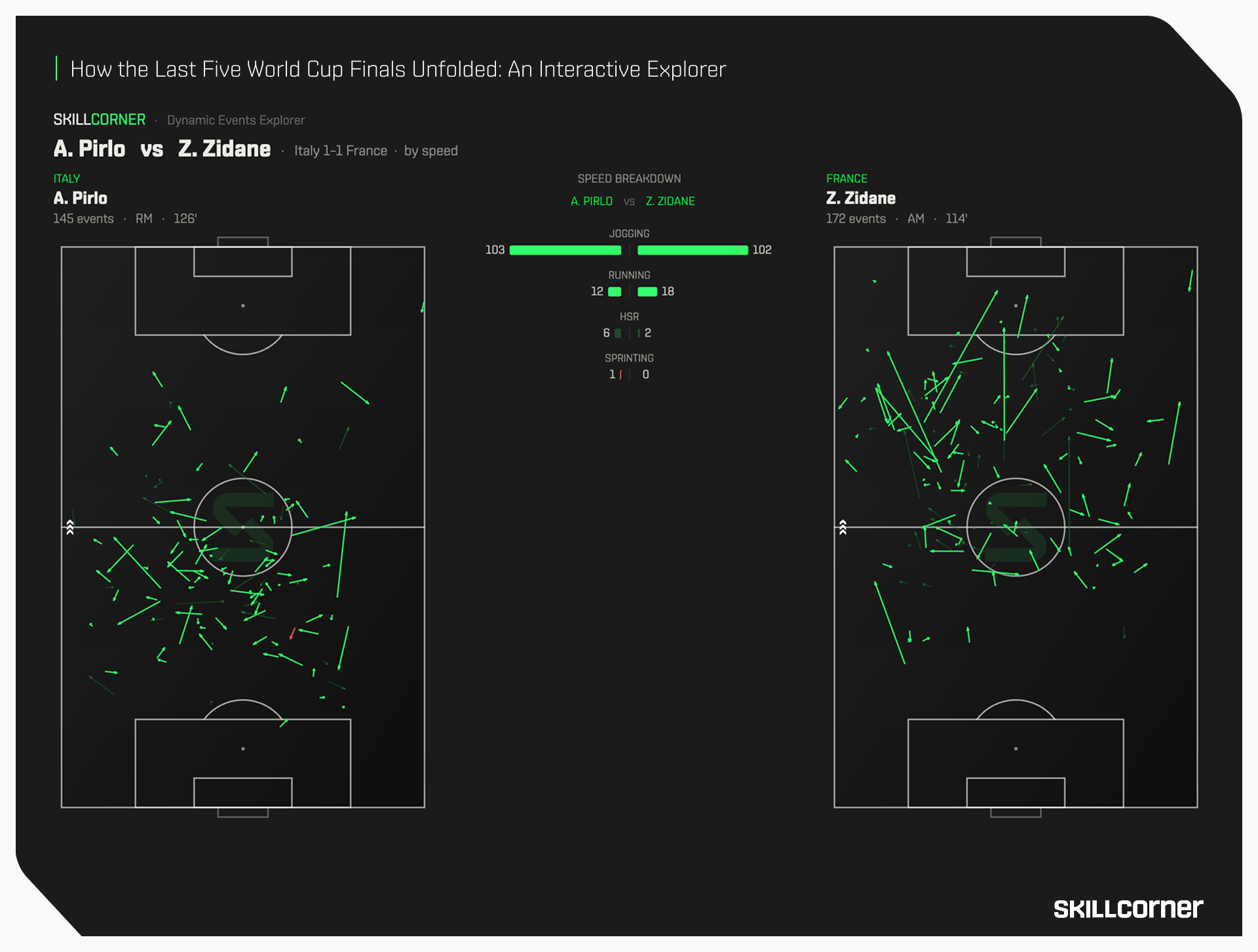
The Head-to-Head tab lets you set any two players from a given final, side by side, event type by event type. In the 2006 final, for example, you can see how two legends influenced the game differently: Andrea Pirlo registered 80 possessions to Zinedine Zidane's 68, yet Zidane recorded more passing options and off-ball runs in less time on the pitch — a contrast in midfield styles that becomes immediately visible once the two are compared directly.
To get you started, we’ve built in four presets on the most recent final – Argentina vs France in 2022 –, but the underlying data supports any angle you may want to pull – by team, player, phase of play, or match period.
Additionally, as an example of what is possible with our Game Intelligence data, we used the Dynamic Events Explorer to trace how two of the tournament’s biggest protagonists, Kylian Mbappé and Lionel Messi, evolved across their two previous World Cup final appearances, four and eight years apart respectively.
Reading Mbappé's runs, from Moscow to Qatar – 2018 vs 2022
Mbappé’s play style saw a shift between the 2018 and 2022 finals. In Moscow, at 19, the Frenchman’s off-ball game in possession was concentrated almost entirely in two run types. Over half of his runs vs Croatia were runs ahead of the ball (11 out of 21), with six runs in behind. In that game, he didn’t make a single coming-short run to help build up play. The numbers point to a forward whose off-ball threat, at this stage, ran in one direction: forward.

By Qatar, that profile had transformed – starting with his position on the pitch, switching from the right to the left flank. Runs ahead of the ball dropped to just over a quarter of his total (nine out of 34), while coming short-runs, non-existent in 2018, made up 17% of his output, alongside runs in support and pulling-wide runs (which both jumped from one to four). The forward-running threat hadn't disappeared, but it now sat alongside movement built to link play and create space for others.
Where Messi found the ball – 2014 vs 2022
Two Messi World Cup finals, two very different pictures of involvement. In 2014, he registered 126 passing options and 49 possessions; in 2022, these figures rose to 194 and 69 respectively — an increase of approximately 54% and 41%. While that can partly be explained by Argentina’s low share of ball possession vs Germany in comparison to the final against France, the real story of the captain’s presence is in where and how that involvement happened.
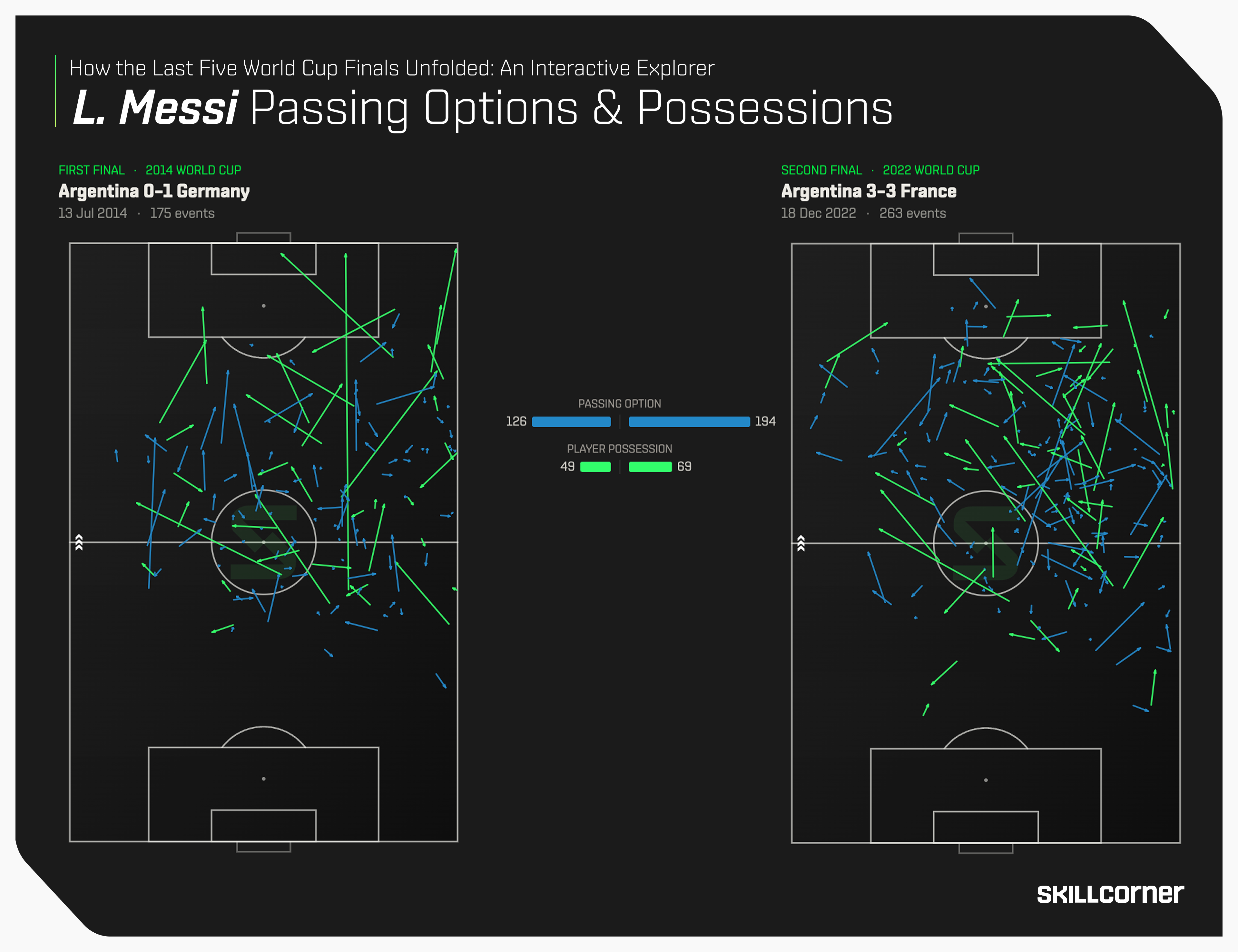
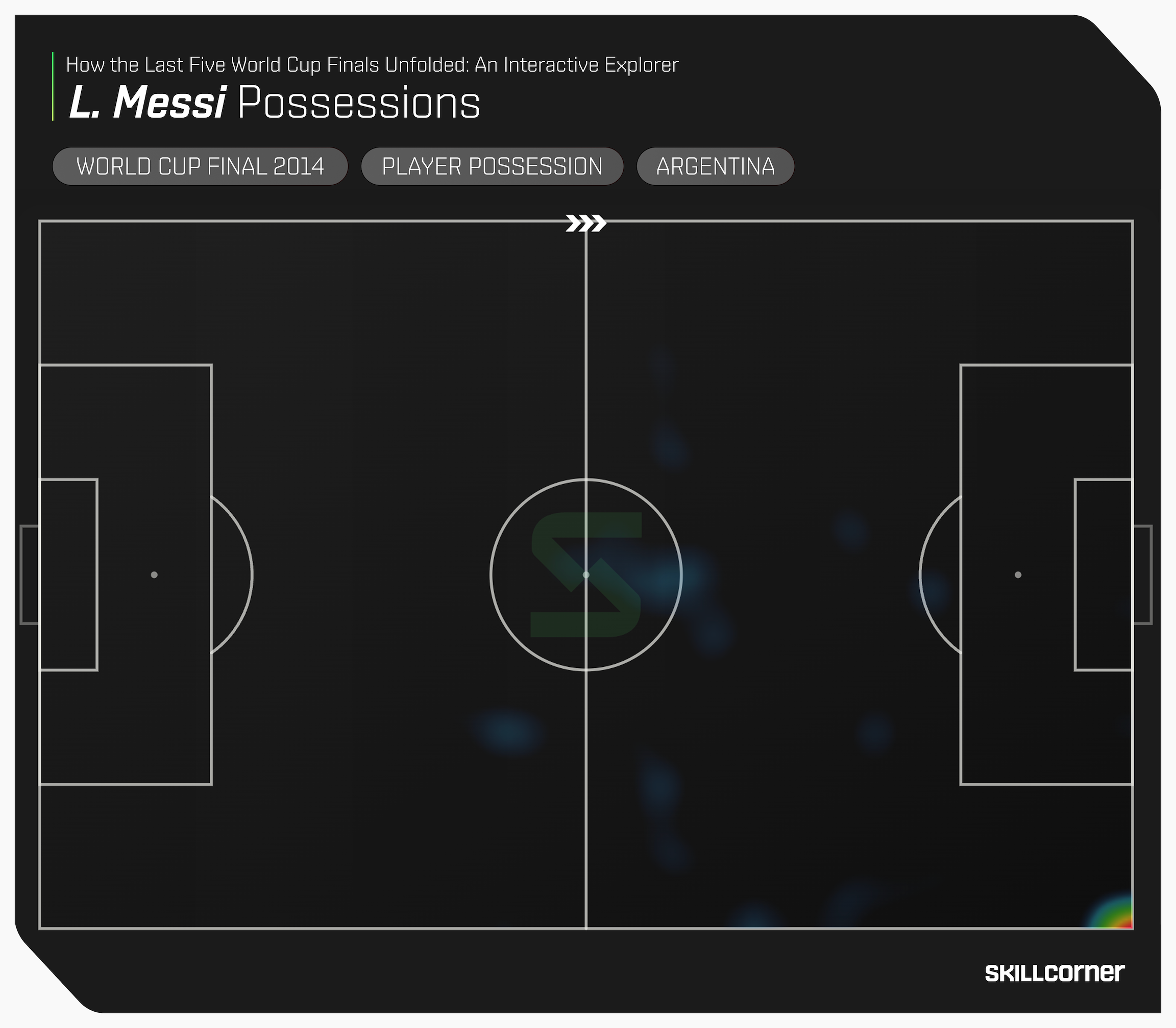
Not only was he more involved in building up from the back in 2022, with a combined 13 instances of possessions and passing options in the build-up phase – compared to one single passing option in 2014 –, the Argentine’s number of passing options and possessions in the finish phase more than doubled, from 41 to 86. His all-round involvement was much more pronounced than eight years earlier, and the heatmaps below make the point visually clear: in 2022, Messi’s hottest zones with the ball sit right on the edge of the box and the right half-space.

Explore the data yourself
The Dynamic Events Explorer below provides direct access to the underlying data for the last five World Cup finals. To conduct your own analysis, filter by match, player, or team, and select the specific phases or event types you want to look into. Once your parameters are set, you can switch between arrow, heatmap, or average position views to map out actions and movement patterns.
Dynamic Events Definitions
.png)
Want to see what else SkillCorner's data can uncover? Get in touch.
%20(1).png)