


Contextual Scouting: The Art of Complementary Squad Building (1/2)
This article explores how to build a complete starting XI using positional profiles and SCOUTED archetypes. The aim is to identify young talent from emerging markets and combine players whose qualities complement each other to form a balanced, cohesive team.
Modern recruitment is no longer about identifying the best individual players in isolation. It is about understanding how different profiles interact, overlap, and amplify each other within a collective structure. A high-level individual can struggle when placed in the wrong role or system, while a more modest profile can thrive when the environment allows his strengths to surface and his weaknesses to be protected.
This article explores how clubs can build squads based on complementary skills by combining position-specific profiles with SCOUTED Archetypes. Using Game Intelligence and Physical data, the aim is to move from isolated player evaluation toward intentional squad design where the collective output or the whole is greater than the sum of its parts.
Rather than asking “Is this player good?”, we shift the question to “What type of synergies can this player unlock when paired with others?”

Scenario: Club with A Development-Focused Recruitment Model
Imagine a club operating in the “next five” leagues with a clear development mandate.
The recruitment strategy prioritises young, high-upside players from emerging markets, offering them a platform to develop, gain exposure and playing time, which eventually can generate meaningful resale value. The objective is not short-term optimisation, but sustainable squad evolution.
This club targets an average starting XI age under 25, builds around learning environments rather than fixed hierarchies, and accepts squad churn as part of its competitive model. In this context, recruitment success depends less on star profiles and more on how well individual skill sets complement each other across units and phases of play.
As a development-focused club, our game model is built around ball dominance and positional control. However, modern football trends have made it clear that technical security alone is no longer sufficient. The game has become increasingly transitional, placing greater demands on physical capacity, robustness, and the ability to repeatedly perform in high-intensity moments on both sides of the ball.
Therefore, we look to identify players who can contribute to a proactive, ball-dominant style of play while also possessing the athletic tools required to survive and exploit transitional moments.
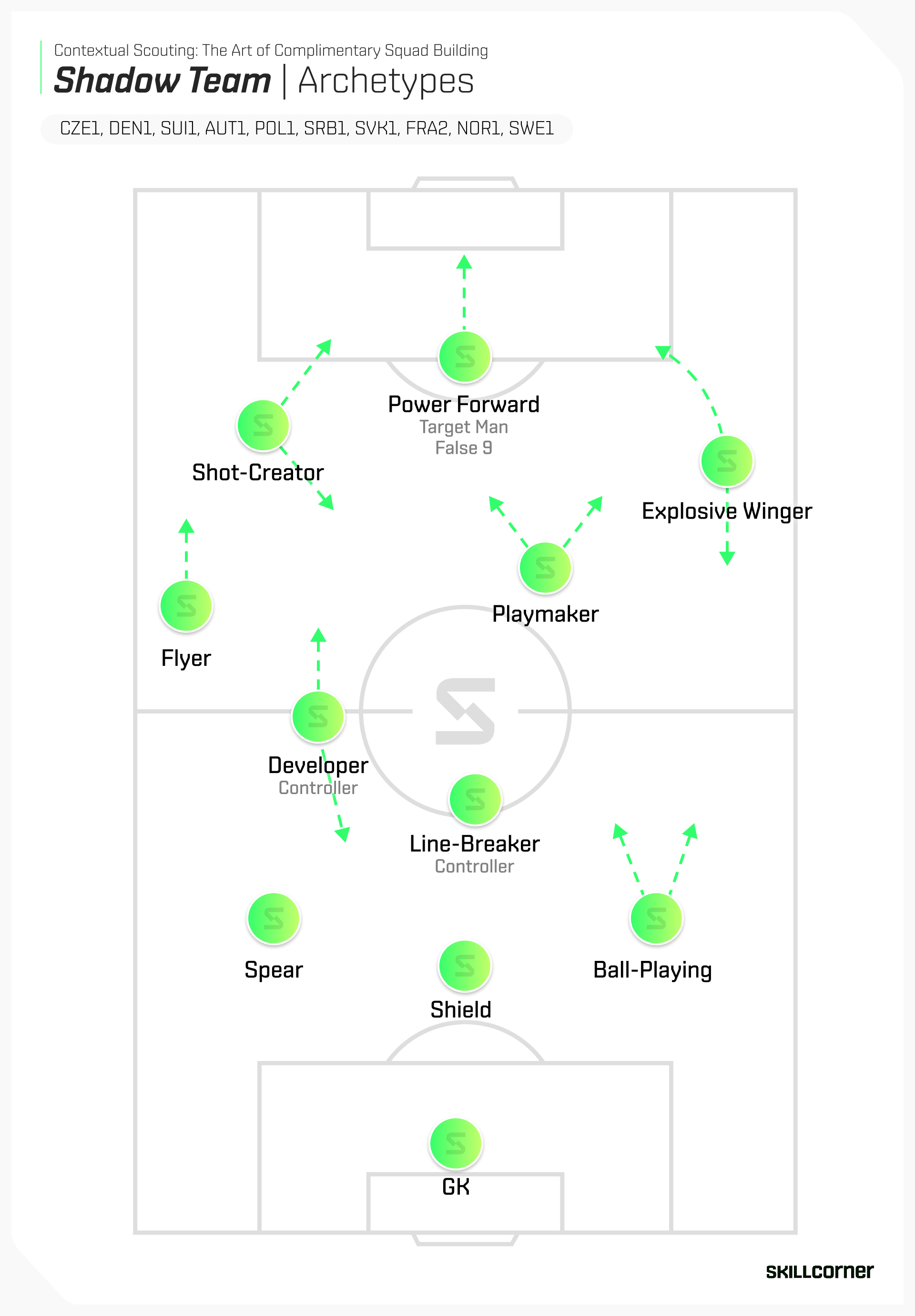
Based on this game model, we have constructed a shadow team composed of positional profiles and SCOUTED Archetypes. This serves as a strategic blueprint for our data-driven scouting process, helping narrow the search toward players whose skill sets align not only with individual roles, but with the collective demands of the team.
Scouting for Defenders
Center backs are arguably the most complex position group to evaluate because they are highly dependent on team context and defensive structure. Furthermore, high engagement volumes in defensive metrics can often introduce noise. Strong defenders may therefore appear almost invisible in the data, as intelligent positioning frequently prevents situations from occurring in the first place.
By dissecting the data more carefully, however, we can still separate profiles and highlight the traits that truly distinguish them. We can also use on ball engagement outcomes for this purpose. This approach was explored effectively in a recent piece by SCOUTED, which introduced a useful spear and shield analogy when analysing defenders through data. Some centre backs operate as spears, characterised by high engagement volumes and proactive interventions, while others function as shields, preserving structure and reducing danger through positioning rather than frequent defensive events.
Our objective is to identify at least one player from each profile. Our method of separating the defenders in the sample is by creating two performance indices, one for spears and one for shields. We visualize the two archetypes in a scatter plot further down.
The scouting pool that we are operating with consists of CZE1 First league, DEN1 Superliga, SWE1 Allsvenskan, NOR1 Eliteserien, SUI1 Super League, AUT1 Bundesliga, POL1 Ekstraklasa, SRB1 Superliga, SVK1 Nike Liga and FRA2 Ligue 2 from the 24/25 season:
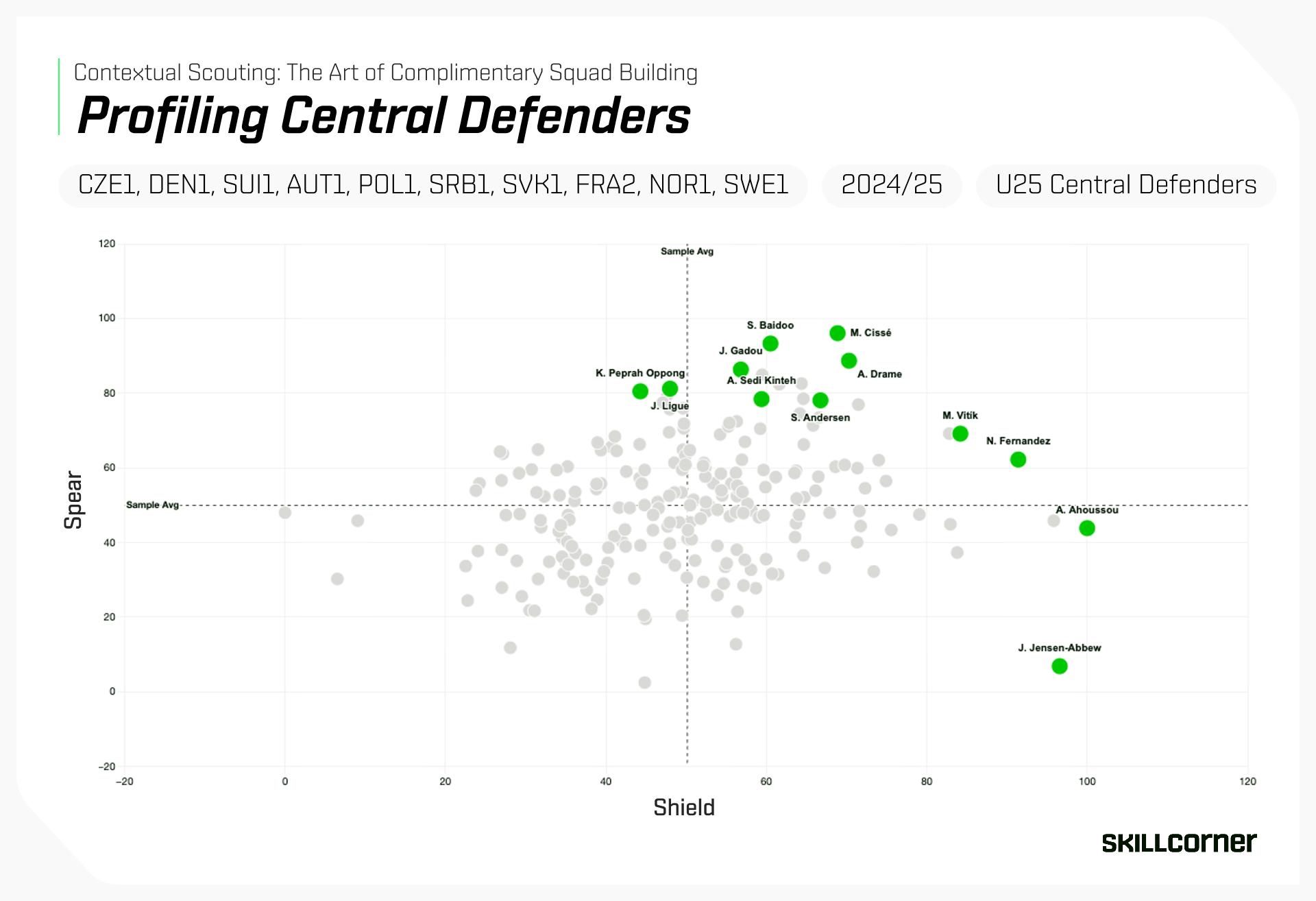
* “Spear and Shield” performance indices created and plotted in the Web App Lab (WAL)
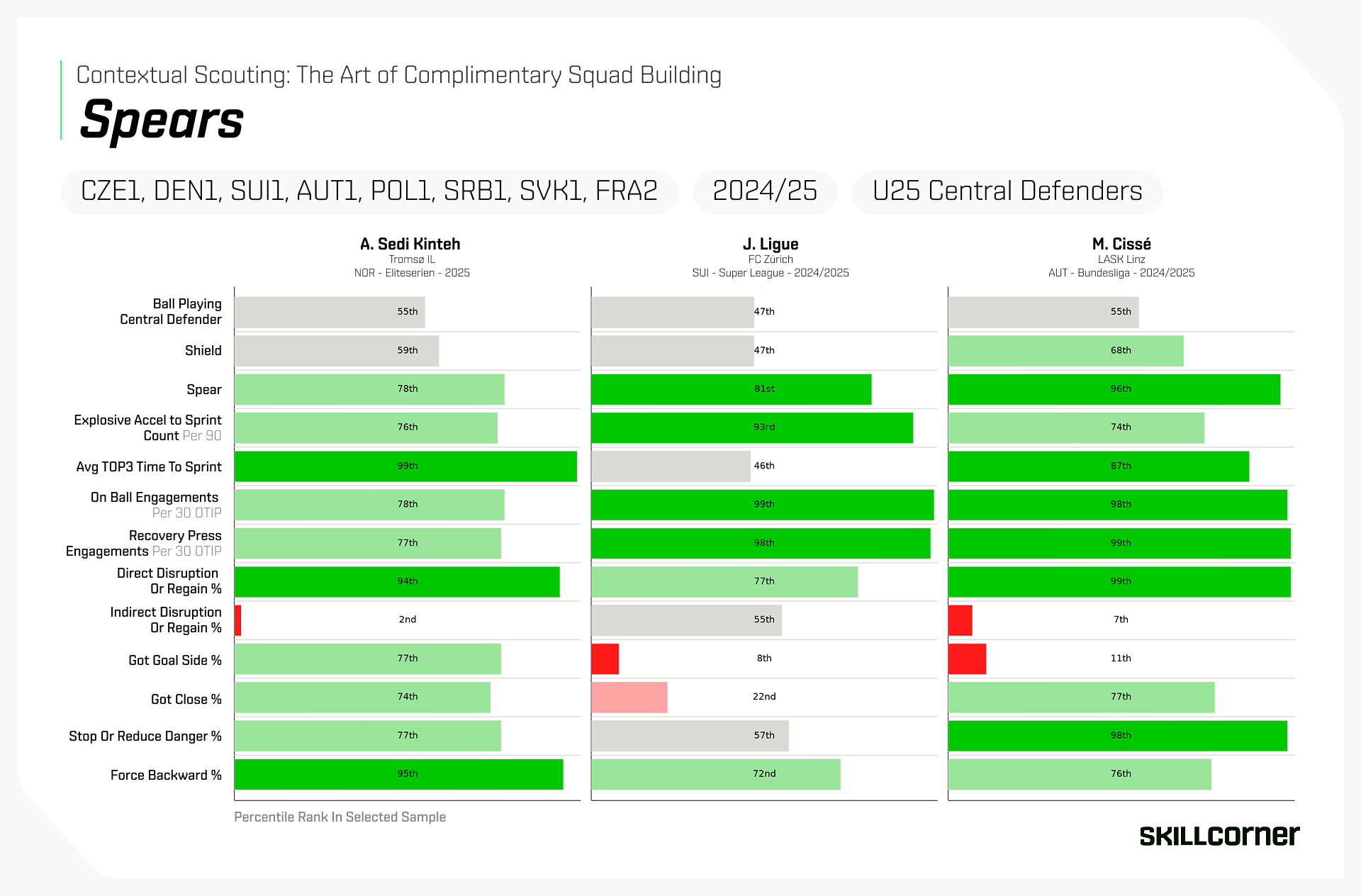
Ranking highest for “spears”, we find Modou Keba Cissé at Lask Linz. He embodies this aggressive archetype as he sits inside the 98th and 99th percentile for On Ball Engagements P30 OTIP and Direct Disruption and Regain Percentage. By researching Cissé more closely, we found that he has already been signed by Aston Villa on a pre-deal agreement before next season - a testament to his potential and a validating sign for our data scouting. Just behind him, we also find two RB Salzburg defenders, Samson Baidoo (now at Lens) and Joane Gadou. This leaves us with three candidates for this role; Adama Drame (now at Wolfsberger), Sedi Kinteh (Tromsø IL) and Junior Ligue, a Swiss youth international who was just recently signed by Venezia and loaned out to Mantova in Serie B. Being left-footed and previously having experience as a center forward, we believe he can fit into our left center back position as a front foot defender and potentially even cover the offensive left back role if needed.
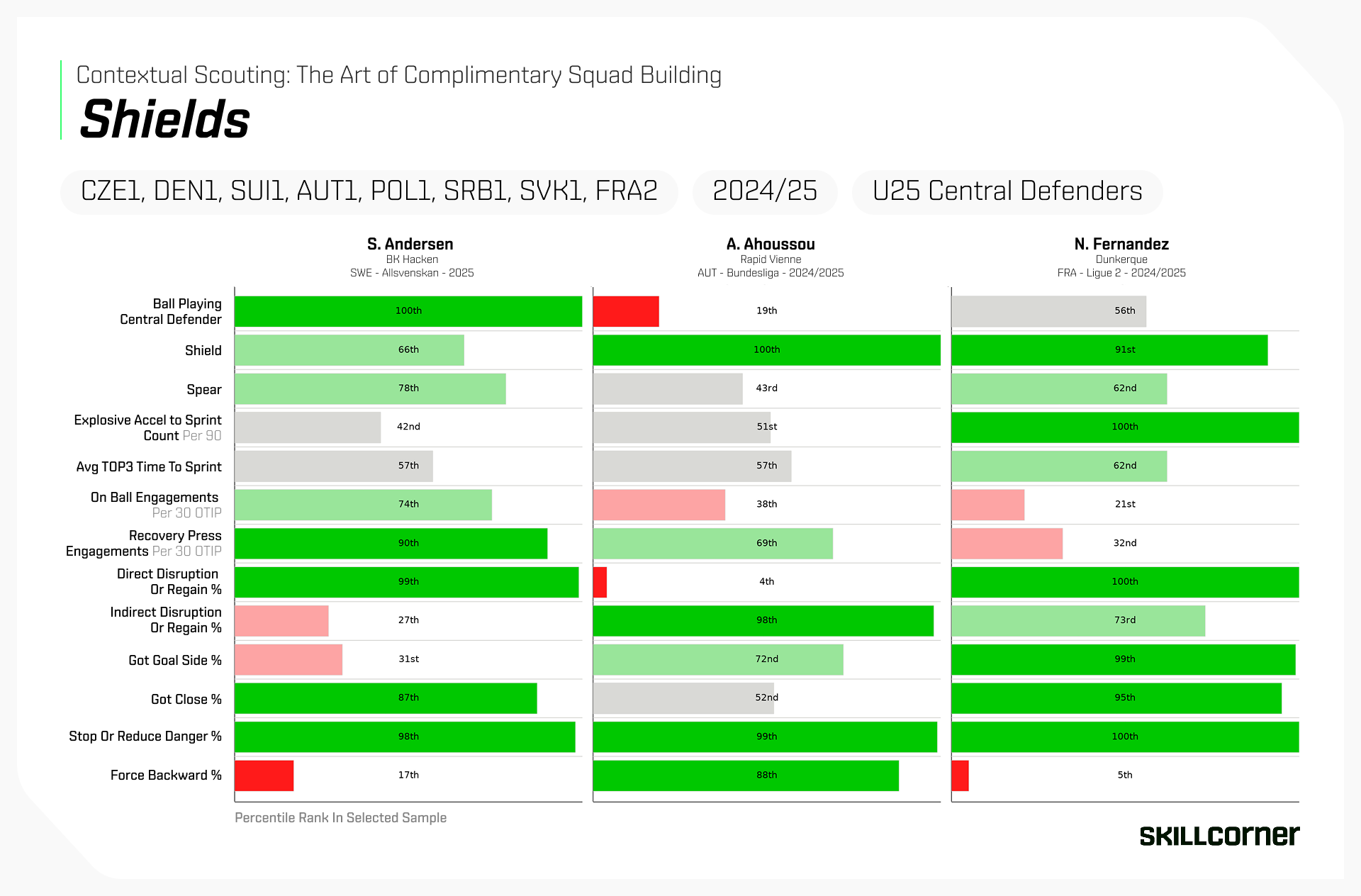
Moving to the center of our defence and focusing, we find Ange Ahoussou with the highest average performance for our “shield” metrics. He ranks within the 98th percentile for both indirect disruption and regain percentage and stop or reduce danger percentage. Nehemiah Fernandez, now at Nancy and previously in the PSG academy profiles somewhere in between a spear and a shield. The same can be said for Silas Andersen (BK Hacken) who we profiled as a rare hybrid defender/midfielder in our previous analysis, How Strategy Can Beat Spending. Not only that, he is extremely proficient on the ball as well - ranking in the 100th percentile for our “Ball Playing Central Defender” index. Therefore, Andersen will be our choice for the ball-playing centre back role on the right side of our back three.
The final defender we aim to sign is the 'Flyer’ archetype, a flying full-back which we also searched for in the mentioned article above. Here, we found several interesting options for both right-back and left-back.
Our chosen player is the 21-year-old South African, Samukelo Kabini, who currently plays left-back for Molde FK in the NOR1 Eliteserien. Kabini is an explosive talent, averaging 5.52 Overlap Runs P30 Tip well within the 90th percentile of young full backs, fulfilling a specific skillset we need for the synergies we want to leverage on the left side of our attack.
Scouting for Playmakers
Our shadow team includes several positional profiles we have previously explored in depth, allowing us to apply earlier findings directly to specific roles.
Last year, we published two extensive pieces on profiling The Modern Playmaker and Pressing Playmakers. The combination of these profiles evolved into a more holistic data profile which we called The Dynamic Playmaker - inspired by the Japanese market and the increased trends and focus on transitions and vertical football.
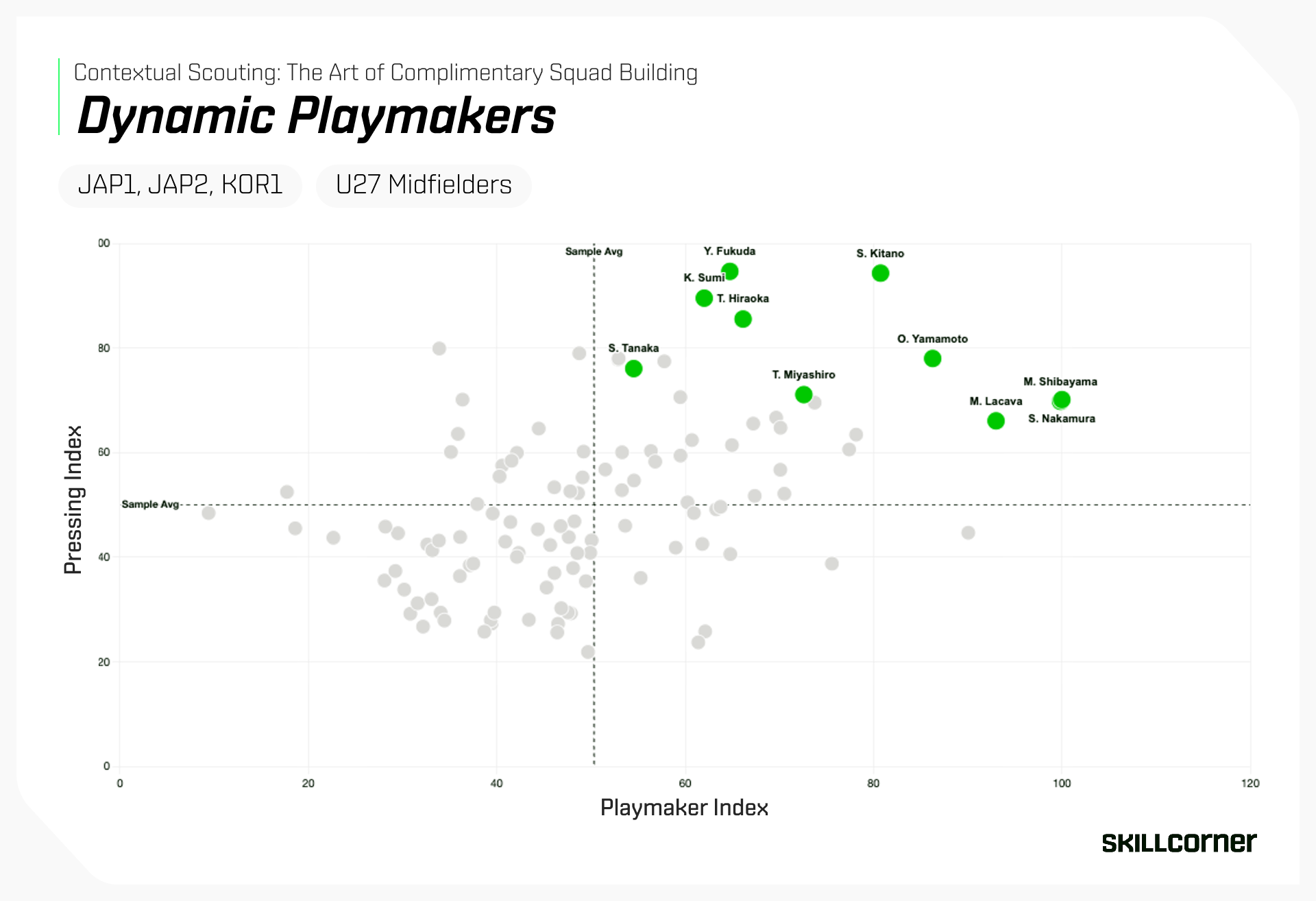
* Scatter plot created in our Web App Lab (WAL): U27 Midfielders in J1, J2, K1 (2025 season)
When merging the two performance indices, our top ranked player was Sota Kitano, who earned a move to RB Salzburg last summer.
However, another profile stood out to us in the J2 League: Ota Yamamoto.
Not only did Yamamoto (21) rank inside the top ten of our overall Total Index Score (IP and OOP), he also featured in our recent collaboration with SCOUTED when they went “shopping” in Asia for the Championship. Yamamoto ranks well above average in both Carries at Speed per 30 TIP and High Intensity Activities per 90 when compared to Championship midfielders, suggesting that his profile translates well to a more transitional and physically demanding environment which is a tick for our recruitment strategy and game model.
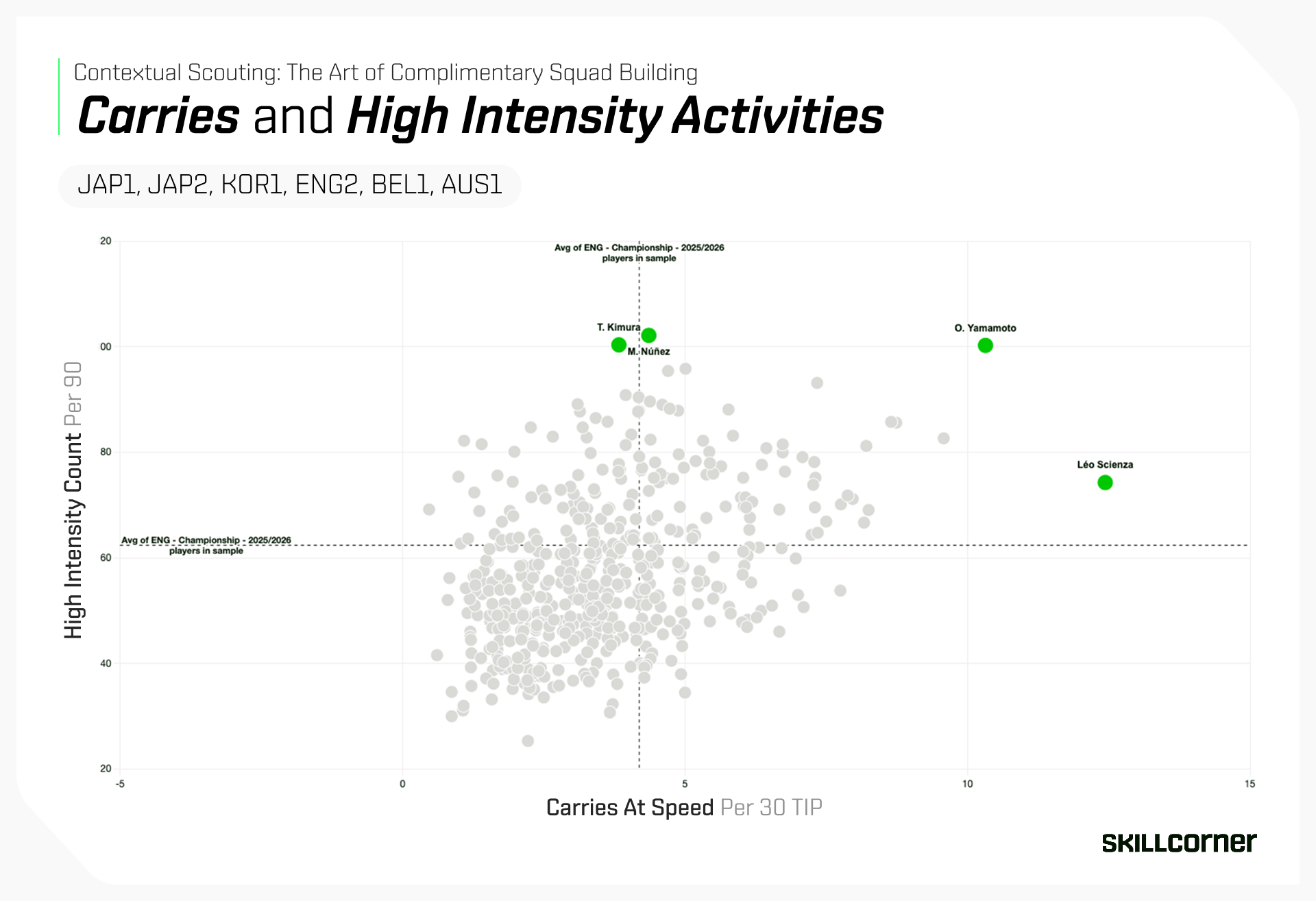
Chart retrieved from SCOUTED: Scouting Asia For The Championship
Perhaps most importantly, Yamamoto offers tactical flexibility. He can operate as a dynamic advanced midfielder but also as a centre forward, giving us optionality within squad construction.
Now on a new loan in the J2-league at Red Bull owned Omiya Ardija, Yamamoto is likely to feature on several shortlists heading into the 2026 season. As a result, he is the first name on our team sheet. A Dynamic Playmaker from Japan.
Scouting for Midfielders
Moving forward with our recruitment, we will remain focused on the midfield for our next signings. Having already identified a dynamic playmaker capable of pressing and creating chances, our goal is to find complementary profiles to complete a “staggered” double pivot.
We believe we can identify different profiles through a single, unified scouting search by looking for distinct skill sets that, when paired, create an asymmetrical yet flexible partnership (if one goes, the other one must stay).
Midfield Archetypes
- The "Developer": A more attack-minded midfielder who contributes directly to goal-scoring and chance creation. We lean on the "Developer" archetype here. This is a player who affects play through continuous off the ball movements in attack.
- The "Controller": A more balanced, defensive-minded presence closer to a traditional "number six" or holding midfielder. This profile is similar to the Platformer Archetype.
- The “Line Breaker”: Similar to the controller in terms of role and positioning but must be able to break the lines. This profile is similar to the Pathfinder Archetype.
To find these players, we have designed a performance index that aggregates both offensive and defensive metrics, effectively modeling a comprehensive "box-to-box" midfielder role.
Our approach is to generate a broad shortlist using this index and then decompose the data for individual players. This allows us to see which specific combinations of talent will best fulfill our tactical role requirements.
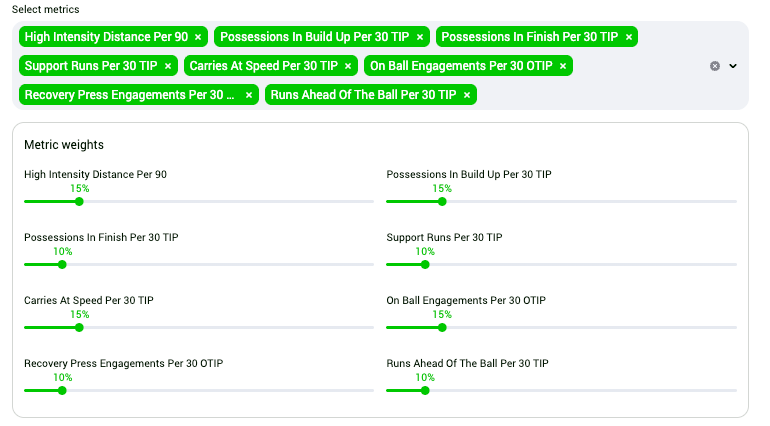
* Performance Index created in our Web App Lab (WAL)
Our scouting pool consists of CZE1 First league, DEN1 Superliga, SUI1 Super League, AUT1 Bundesliga, POL1 Ekstraklasa, SRB1 Superliga, SVK1 Nike Liga and FRA2 Ligue 2 from the current 25/26 season.
The bar chart below highlights the 15 top midfielders identified by our performance index:
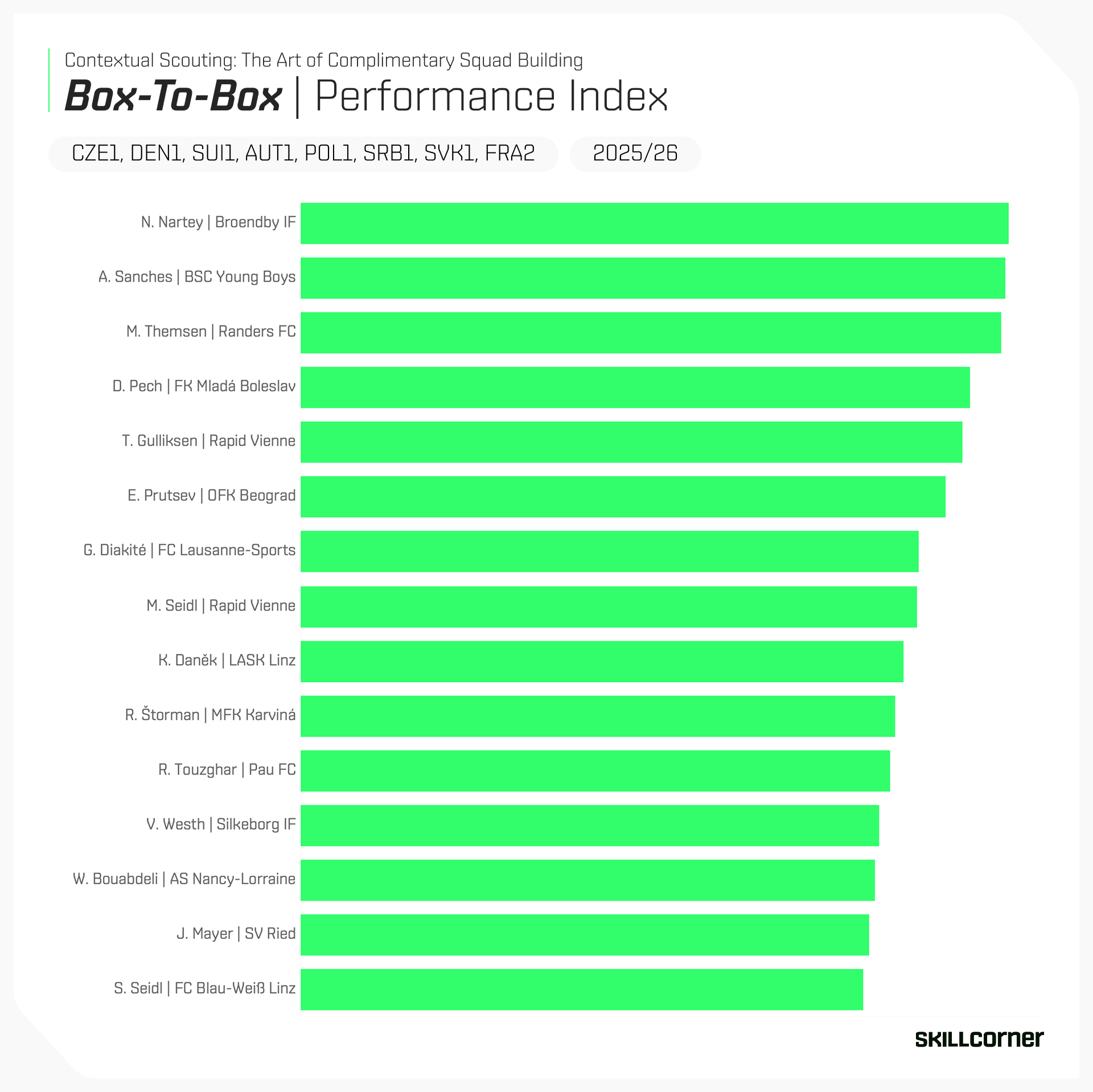
At the top of the ranking, we have Noah Nartey who recently signed for Olympique Lyon. Nartey has taken big steps since we first profiled him as a Scandinavian Breakout Star, now much more involved in the Finish Phase. This is reflected in the breakdown below, ranking within the 92nd percentile for “P-Finish”. Still, he also shows up in the Build Up Phase when needed, shown in his 59th percentile score for possessions in this phase.
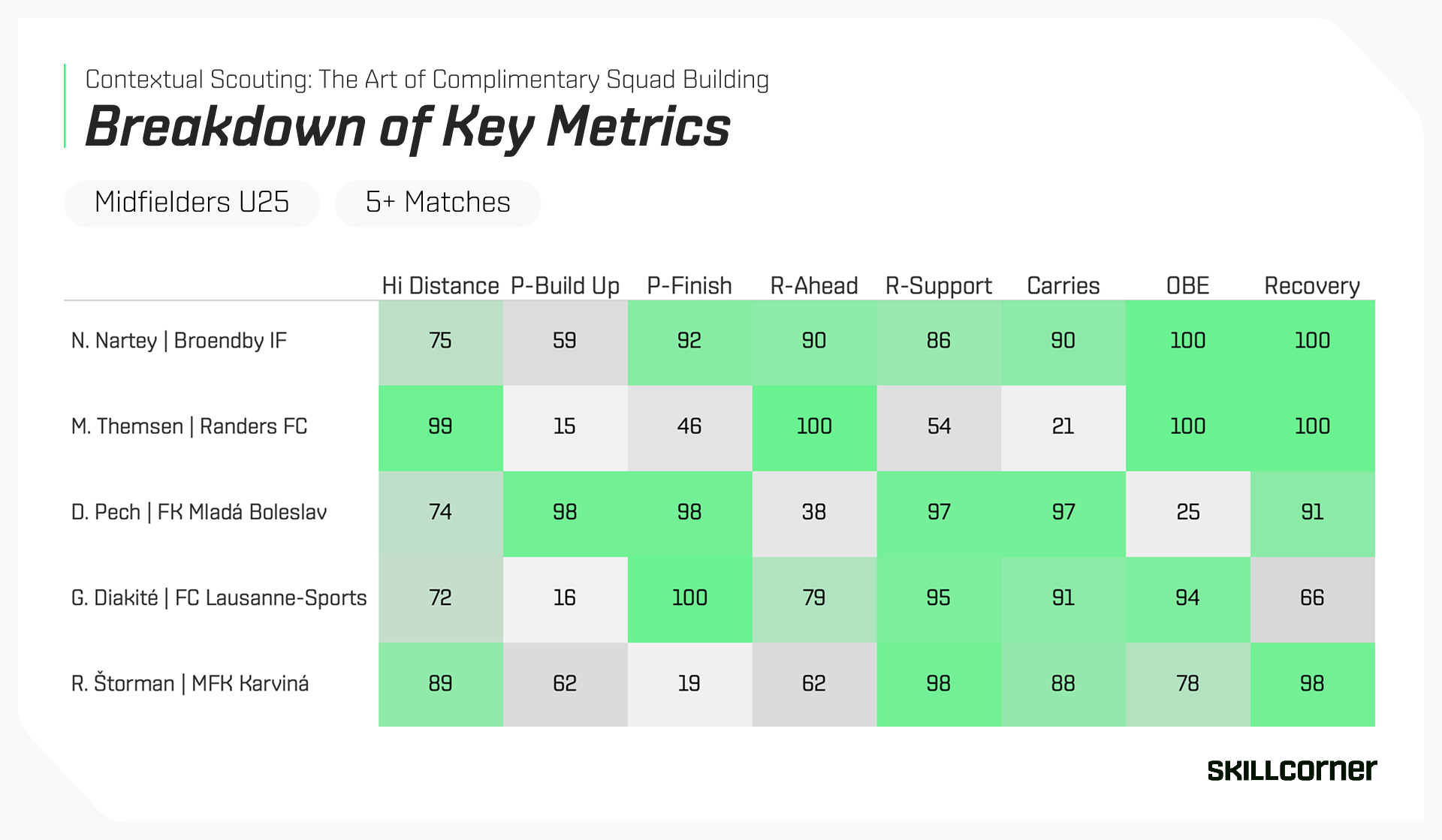
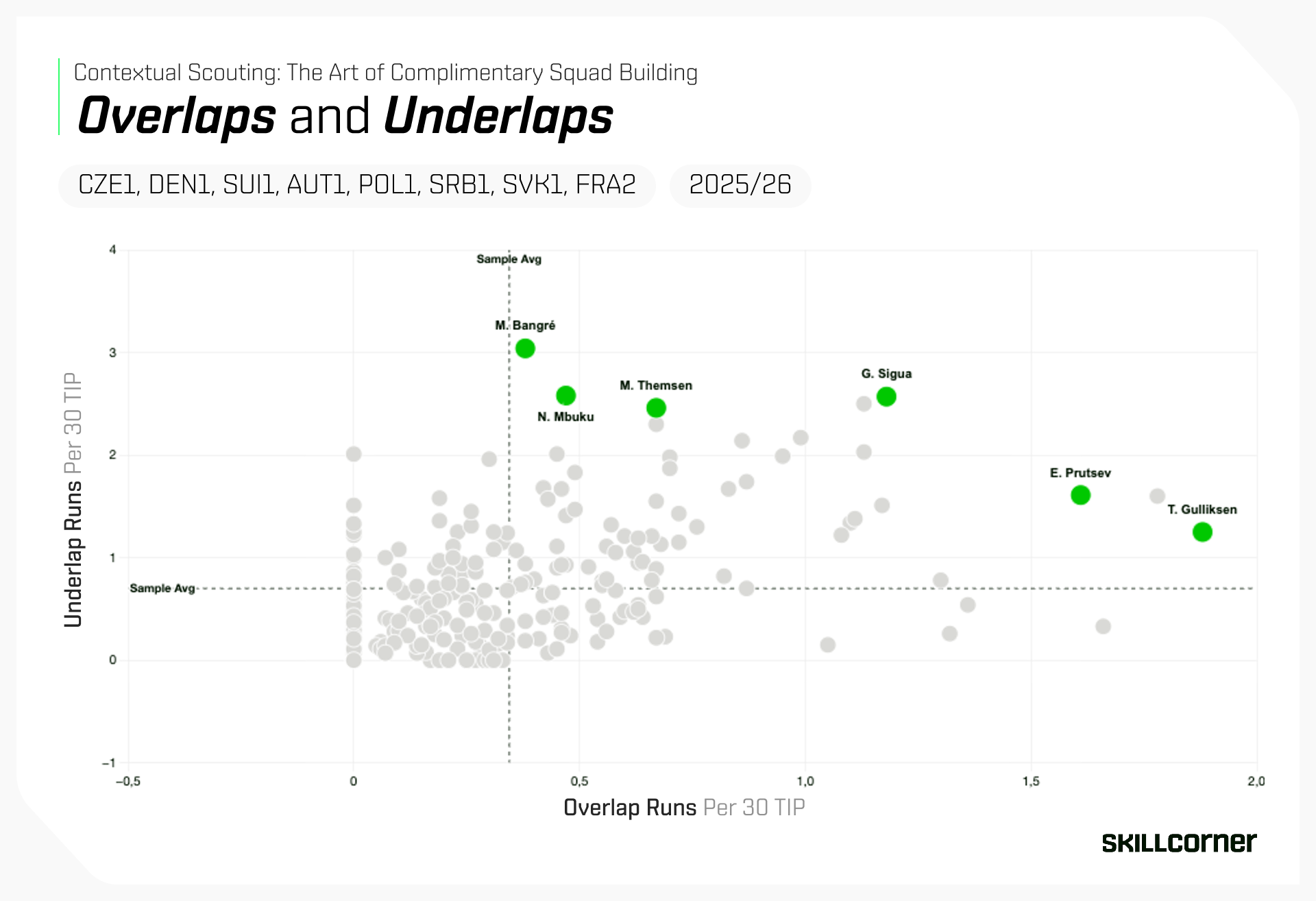
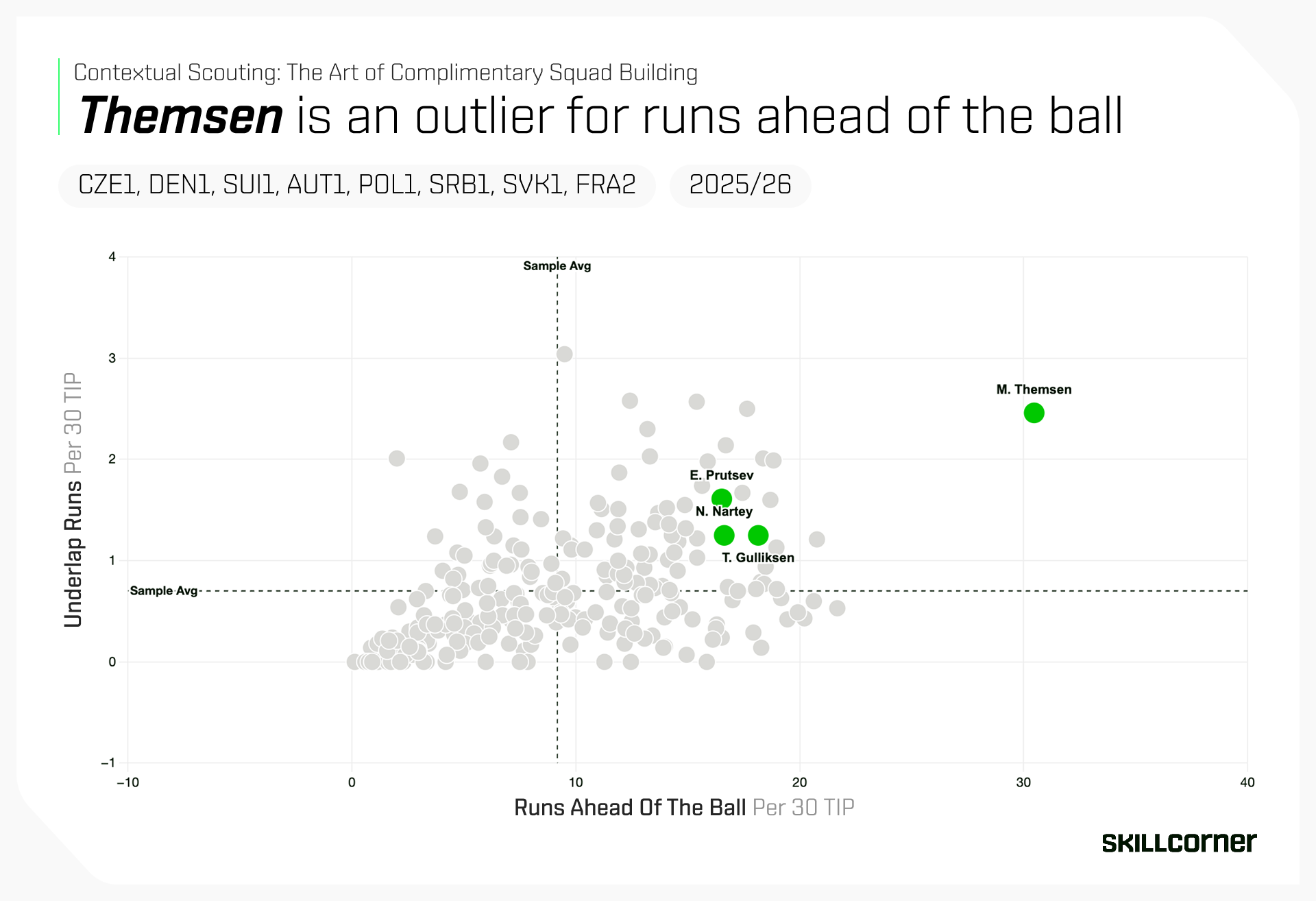
Besides Nartey being a reference profile for the complete Box-to-Box role, we have picked out four other profiles from our list that we believe can be potential candidates for playing across our two positions. The first candidate is Mike Themsen (note: low sample size of 5 games) who profiles close to the Developer Archetype as he is a willing runner both offensively (R-Ahead) and defensively (HI Distance + OBE + Recovery). He would be the perfect pick to help create space and combine with our winger and flying full back. We can support this by visualizing his output for underlaps and overlaps as well.
* Scatter plot created in our Web App Lab (WAL)
As we can see, Themsen has a high underlap frequency with 2.46 runs per 30 TIP, and he is an outlier when it comes to runs ahead of the ball. Gulliksen leads all players in overlap volume averaging 1.88 runs per 30 TIP. We believe that the combination of underlaps and runs ahead of the ball is the most relevant combination for the developer archetype.
Another option worth considering for our midfield composition is Gassou Diakhité - a technical and versatile profile who receives the ball a whole lot more averaging around 25 possessions P30 Tip in the Finish phase. However, Diakhité has also featured 8 games as a center forward and is very much a threat in attack while he also possesses the skill to set up teammates from midfield position. This is reflected by his 6 goals and 6 assists so far this season for Lausanne in the Swiss Super League. Although Diakité seems like quite the offensive profile, he does rank in the 94th percentile for OBE as well which makes us confident that he can fit well within our team.
For our Controller Profile, we have picked out David Pech and Rok Storman. Pech is a high volume midfielder who gives us the control we need in build up and he can also perform the same function in the finish phase. Storman, on the other hand, does not average as high possession counts across phases, but he will more often attempt to break the second last line:
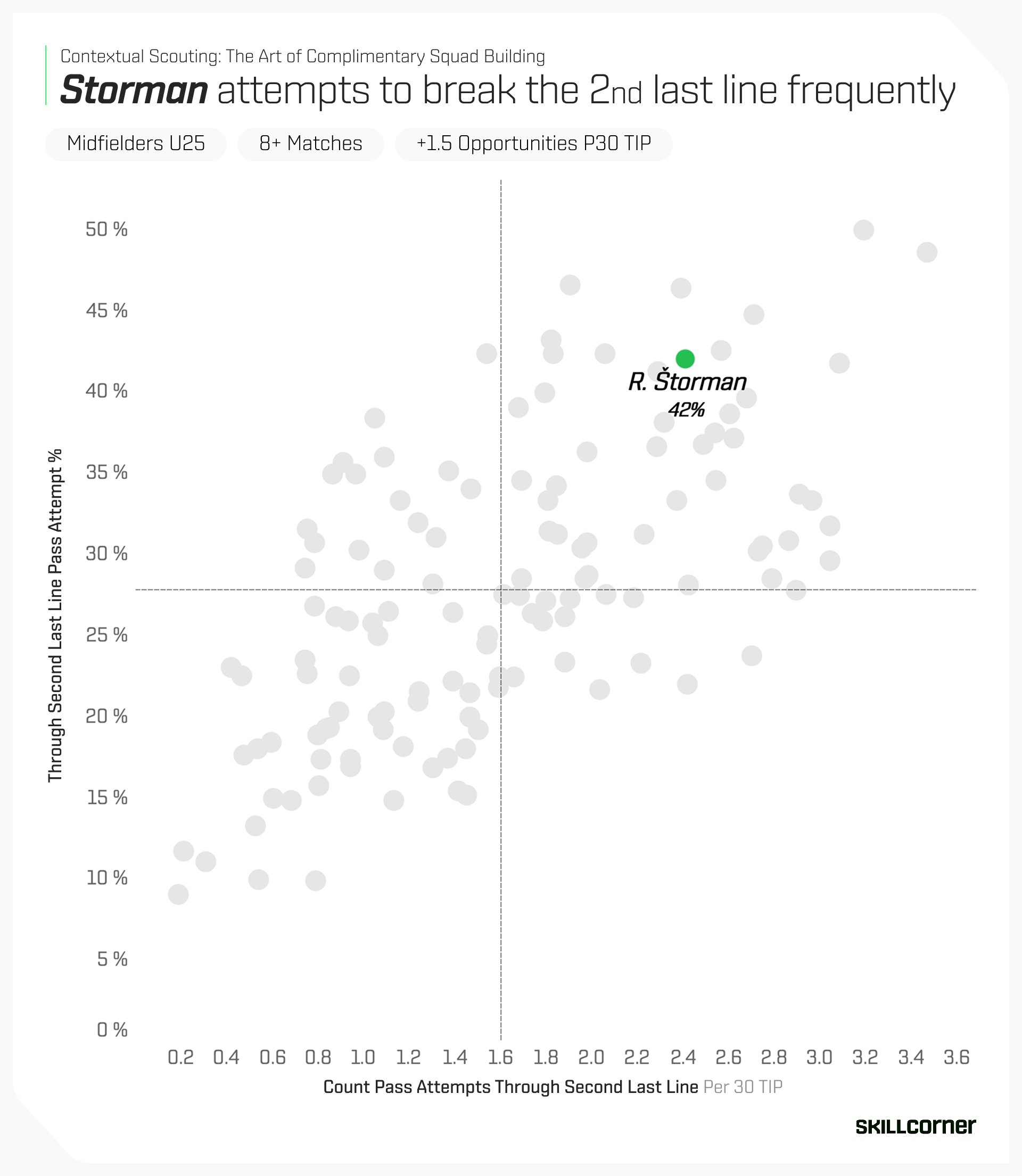
As we can see, when given the option, Storman attempts 42 per cent of his passes through the second last line - an important skill for a deeper midfielder. Pech is not included in the scatter plot due to a smaller sample size, but even after lowering the match threshold he remains below average with just 19 per cent.
Pech may provide the control we need in the build up phase, while Storman offers greater verticality through his line breaking. Viewed together, they could potentially form a well balanced double pivot. For now, we will include both on the shortlist and in the shadow team for further monitoring. In theory, we could utilize three different profiles depending on the game context; Themsen as our developer, Pech as a controller and Storman as a line-breaker. Diakhité becomes our second option in the playmaker role along with Yamamoto.
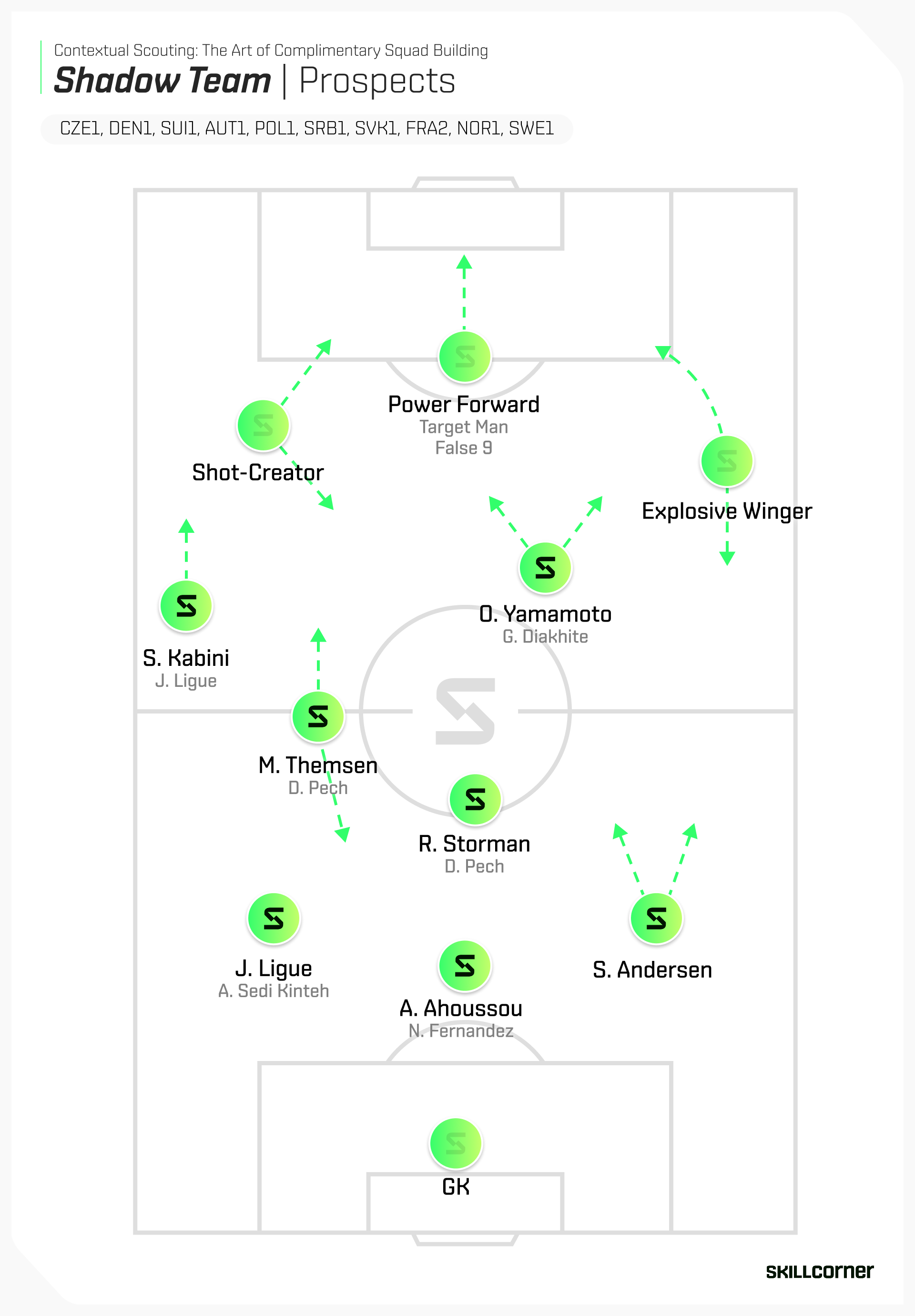
So far, we have focused on building the spine of the team, scouting central defenders and different midfield archetypes. In part two of this squad building exercise, we move further up the pitch and turn our attention to the attacking line, where wide attackers and center forwards will complete the picture.
Get an overview of all the SCOUTED Archetypes here.
To read the part 2 of the analysis, click here.
%20(1).webp)
.webp)