


Game Intelligence Applied: Analyzing Centre-Backs Defensive Behaviour
.
For years, evaluating the behavior of center-backs, and specifically defining their defensive style, has remained a significant challenge for scouts and analysts alike.
Historically, the industry has relied on event data—such as tackles and interceptions—which only record direct actions on the ball. Consequently, defensive analysis has long been hindered by a lack of situational context.
With scouting and recruitment increasingly shifting from pure talent identification towards contextual fit, this limitation has been further exposed.
SkillCorner’s On-Ball Engagements–part of our Game Intelligence suite–provide a solution, going far beyond traditional defensive metrics to allow you to finally identify and evaluate specific game situations relevant to a defined game model.
On-Ball Engagement metrics are categorized into four distinct action types that capture dynamic interactions with the ball carrier that do not necessarily involve direct contact with the ball:
- Pressure: an individual defensive action where a single player moves forward or laterally to engage the ball carrier.
- Pressing: a coordinated defensive effort involving multiple players acting within a structured chain.
- Counter-pressure: defensive actions triggered immediately after a loss of possession (within a 3-second window).
- Recovery pressure: defensive actions where a defender, positioned ahead of the ball, tracks back to apply pressure.
These allow us to look at center-backs through the lens of the defensive principles they execute on the pitch, with a clear objective: to enable football practitioners to profile players, mitigate adaptation risks and streamline the adjustment process.
High Line Defending: Stepping Forward, Covering Space, Recovering when Beaten.
An increasing number of teams deploy aggressive high lines and man-orientation systems to disrupt opposition build-up and, where necessary, directly challenge positional play.
Defending within these proactive structures requires center-backs to constantly manage space, and we have identified three critical tasks that encompasses: stepping forward to engage a receiver, dropping off to cover depth behind the line, and executing recovery runs whenever the initial press is bypassed.
By leveraging the flags within the On-Ball Engagements (OBE) dataset, you can now construct bespoke metrics to quantify these (and more) behaviors. This allows pinpoint exactly which players are most frequently exposed to high-line defending scenarios.
Stepping Forward
We look for OBEs where the centre-back moves forward to engage the receiver, potentially breaking the defensive line.
.gif)
Covering Space in Behind
To measure a player's ability to cover depth we isolate backward trajectories where the defender was initially positioned goal-side, then tracks an opponent.
%20(1).gif)
Recovery Runs
High line defenders are inevitably required to track opponents back toward their own goal. We isolate specific instances where center-backs find themselves positioned ahead of the ball and must rapidly recover ground to close the gap to the opponent.
%20(2).gif)
When mapping these metrics against one another for center-backs across the Big 5 leagues during the 2025/26 season, distinct profiles emerge. Players such as Lucas Beraldo, and Illia Zabarnyi demonstrate a high propensity for covering the space in behind, while Willian Pacho indexes exceptionally high for stepping forward.
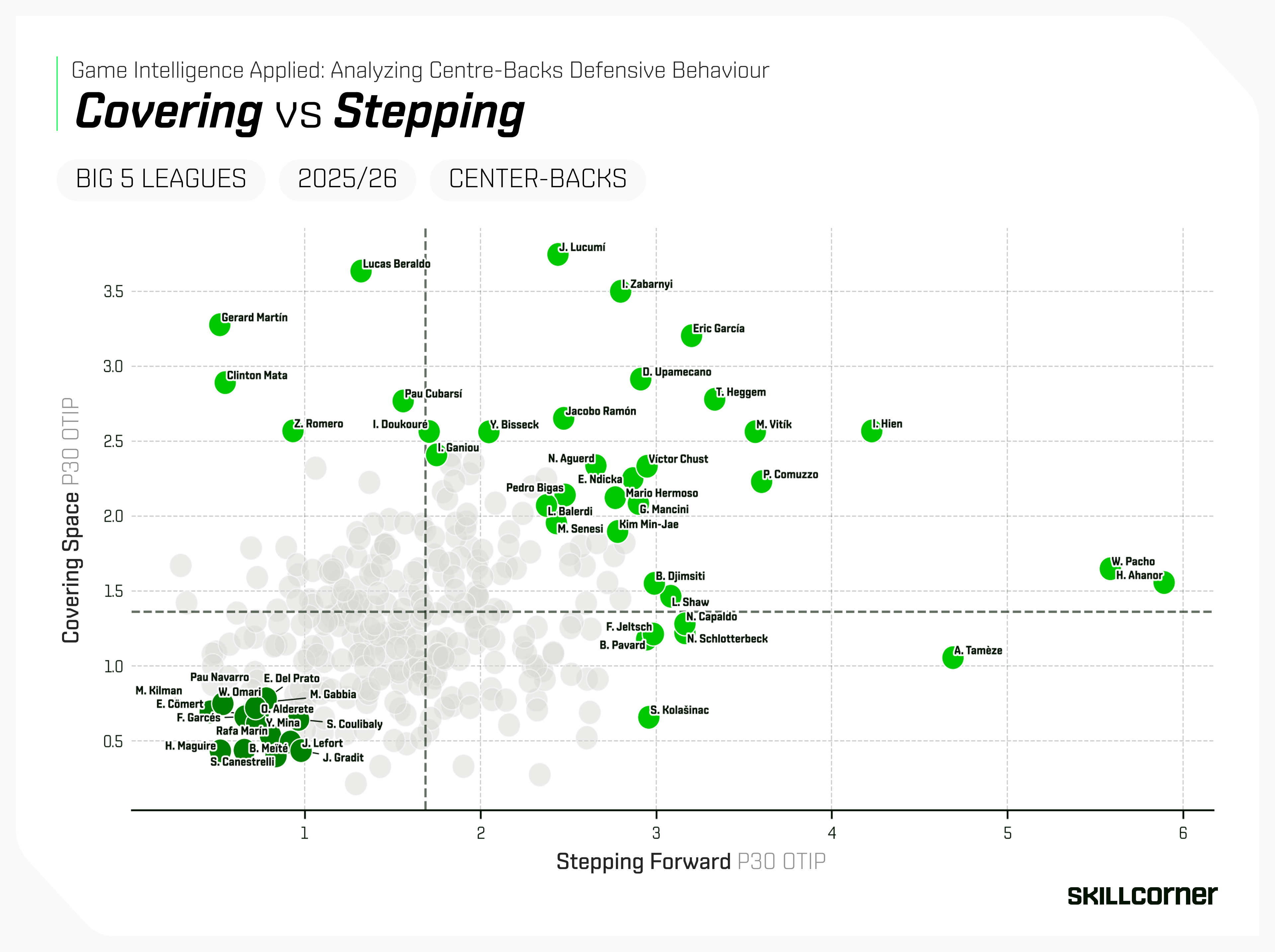
This prompts further exploration: are we witnessing the emergence of specific trends in center-back partnerships? In PSG’s case, Pacho appears to be the primary aggressor, breaking the defensive line to step forward, while Beraldo and Zabarnyi are more inclined to cover depth.
Defenders in systems that favor man-orientation over collective zonal principles—Atalanta, Roma, Bologna, and Bayern Munich—rank high across both metrics.
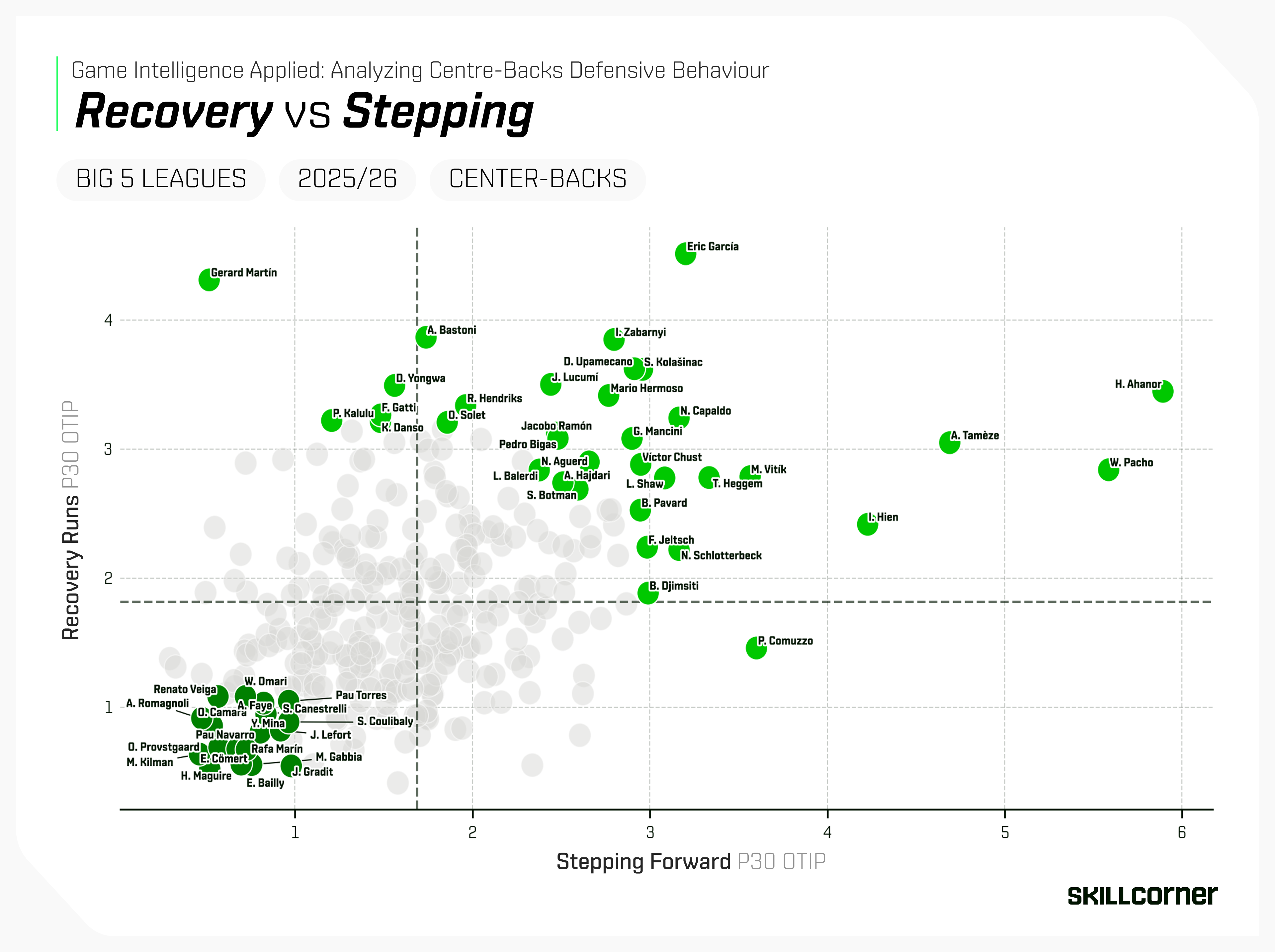
And if we factor recovery runs into the analysis, more profiles arise.
Low Block Defending: Protecting the Box
Not all defensive actions take place in open space. When a team adopts a deep defensive structure, the demands on the center-back shift significantly.
The priority moves from space management and proactive engagement to box protection and shot prevention. We categorize this typical low-block behavior into two distinct metrics:
Protecting the Penalty Area
The amount of times a centre-back performs an on ball engagement beginning in the penalty area, in a low block scenario.
.gif)
Protecting the Goal
Isolates situations in which a defender engages a ball carrier who has a high probability to turn possession into a shot, preventing easy chances.
.gif)
The combination of these two metrics surfaces players heavily involved in defending within the penalty area.
The real value, however, is generated when we bring together the five behaviours to differentiate players according to their playing style. By developing custom indexes (built by means of a Z-Score* calculation) we create a complete picture.
*This score compares a player’s performance against their peers, converted into a simple 0–100 scale. A score of 50 represents the exact league average, while scores closer to 100 highlight elite, standout performers.
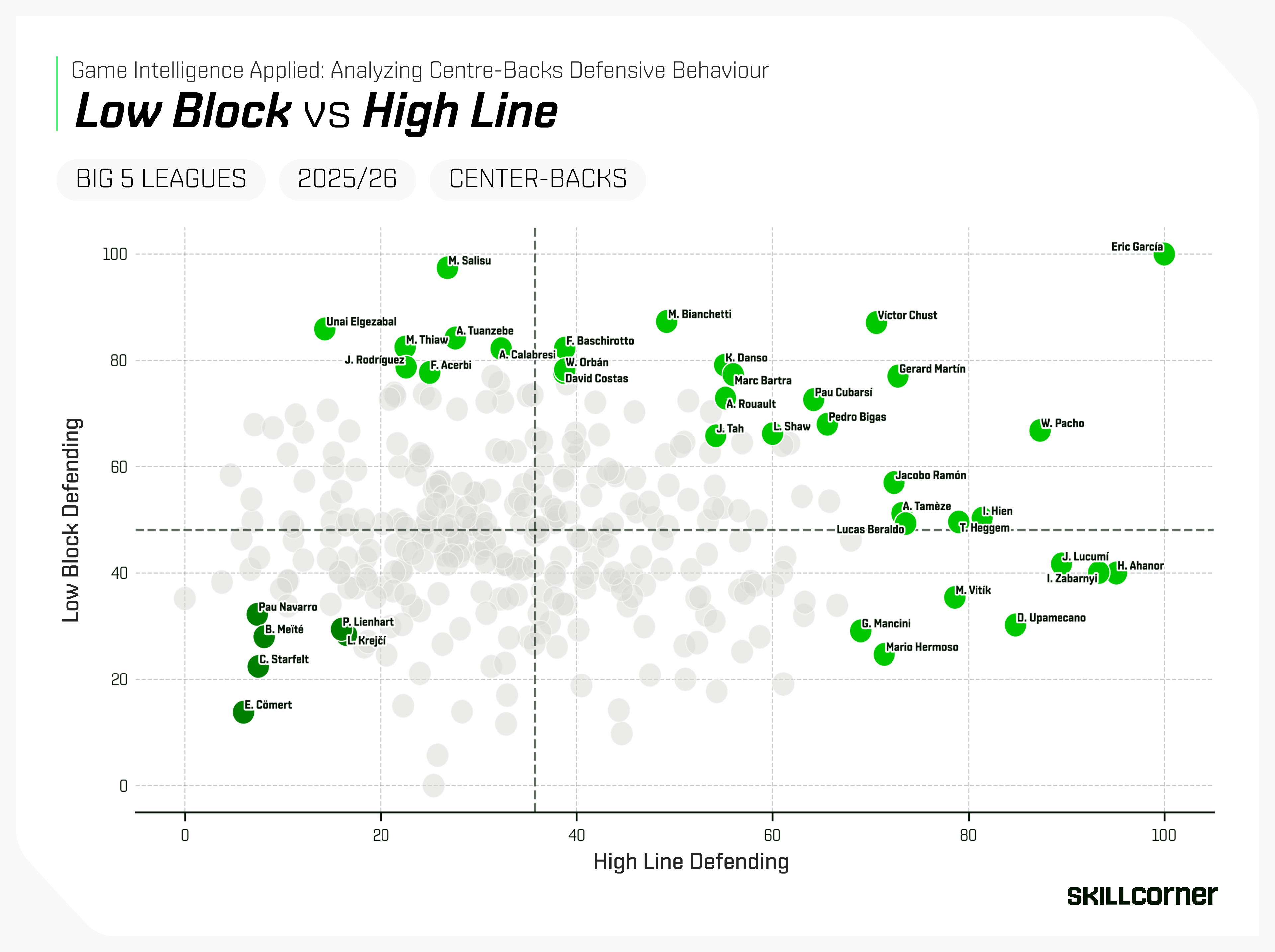
Players in the bottom-right quadrant are used to the high-line defensive tasks identified above—stepping forward, covering space, and recovery runs.
In the top-left quadrant, we find center-backs who perform the highest share of On-Ball Engagements (OBEs) related to box and goal protection.
The remaining two quadrants offer a different narrative. In the top-right, we find players used to both defend a high line and remain active within the box.
The bottom-left quadrant features players with a lower frequency of OBEs in both scenarios. These players may operate primarily in mid-blocks or are simply less frequently required to engage the ball carrier. This area asks for further analysis.
What’s Next?
The history of the transfer market is filled with examples of good players who simply weren’t the right fit for a specific environment. While categorizing forwards by their movement profiles—link-up players, runners, or target men—has become standard practice, defensive behavior has remained largely overlooked in stylistic profiling.
With On-Ball Engagements, we now have the relevant context to better quantify the intricate art of defending, particularly when coupled with other metrics.
Bespoke metrics such as "stepping forward" and "covering space" can be assessed alongside Physical Data, to understand if a center-back in a high-line system possesses the necessary intensity and explosiveness to execute the role effectively. They can also be paired with others from our Game Intelligence suite to evaluate multiple aspects of the game—from physicality to efficiency.
What distance do center-backs cover when stepping forward? At what speed? Do they successfully force the opponent backward, or are they bypassed? What is the outcome following a recovery?
These questions, and many more, can be answered by exploring the granularity of On-Ball Engagements.
.jpg)

