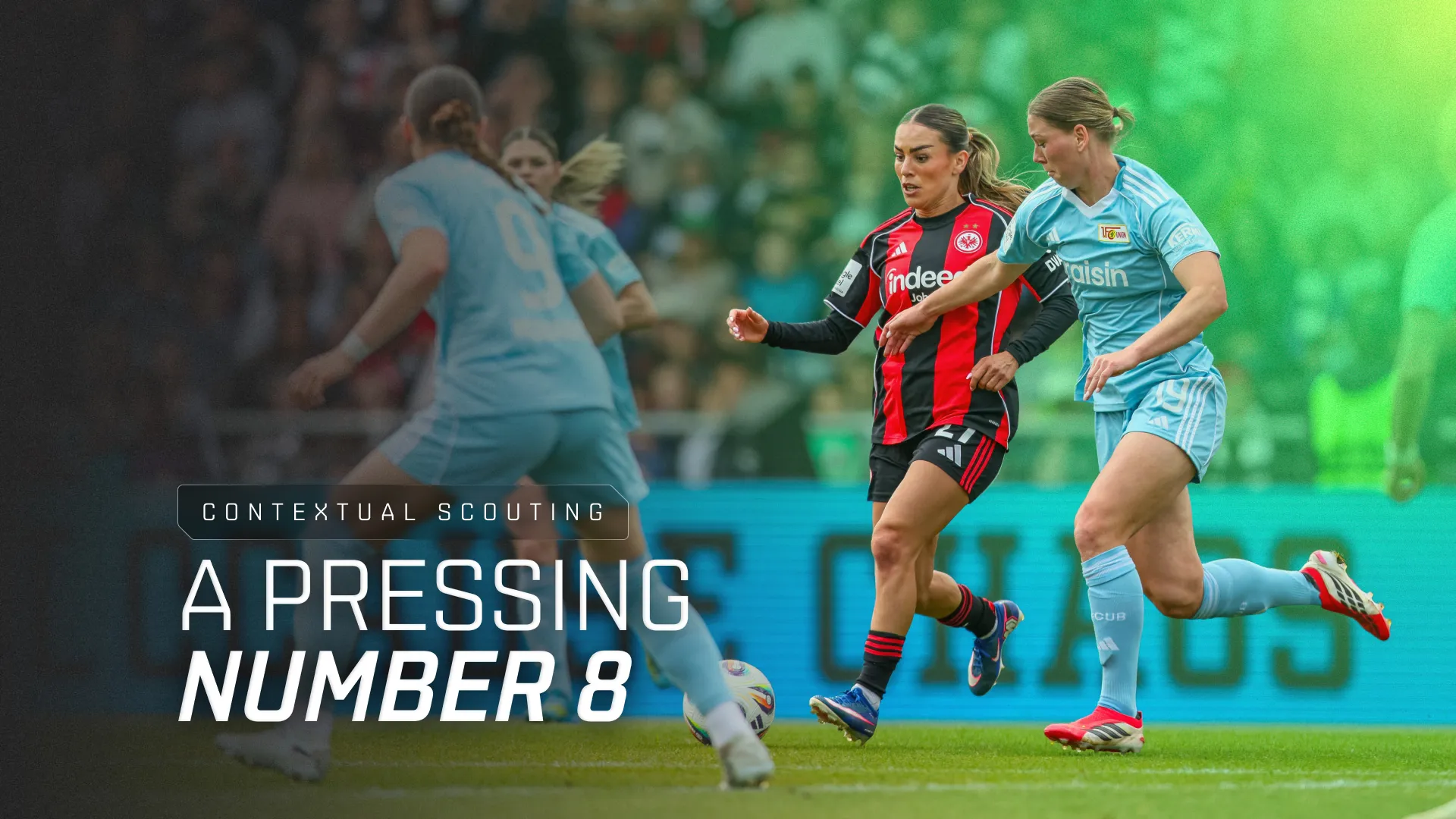
Contextual Scouting: A Pressing No. 8 in Women's Football
We used our Game Intelligence data and new dedicated Women's Physical Data to identify players capable of performing as a number 8 in an active, high-pressing team.
This summer, Real Madrid's reported $1.5m+ signing of 19-year-old Felicia Schröder from BK Hacken was promoted as the most expensive transfer in women's football history, though FIFA's own records suggest Grace Geyoro's $1.9m move to London City Lionesses last year still holds that mark.
Whichever figure is right, the trend isn't in dispute: transfer fees at the top of the women's game keep climbing. However, FIFA's 2024 "Setting the Pace" Benchmarking Report found that even so, 85% of clubs in the world's top professional women's leagues are still losing money or just about breaking even. So a signing that doesn't work out on the pitch is a cost few clubs can afford.
To manage that risk, teams increasingly lean on data to scout with more precision by searching for profiles adapted to their exact needs. To that end, SkillCorner provides:
- Physical thresholds built specifically for the women's game.
- Game Intelligence data that helps form a rounded picture of a player’s on and off-ball contribution.
In this article, we'll build a recruitment profile for a club whose identity out of possession leans heavily on pressing high, and who are looking for a No. 8 that fits their desired profile.
The brief is for a player who can run all game long, not just the first 20 minutes; who presses like she means it in the final third and either wins the ball back or disrupts the opposition; and who can also contribute meaningfully in possession via ball progression and/or chance creation.
We'll analyse midfielders across three key output types — Physical, Pressing, and Offensive — and then combine the three into a single index aligned to the club’s philosophy.
The search will span eight European leagues: the Big Five (England's Women's Super League, Spain's Liga F, France's Première Ligue, Germany's Frauen-Bundesliga, and Italy's Serie A Women), alongside three Scandinavian leagues: Sweden's Damallsvenskan, Norway's Toppserien, and Denmark's A-Liga.

1. Physical
Physical capability is the foundation the profile is built on: a player who can't sustain her output for 90 minutes can't deliver on the rest of the brief either.
This is the part of the analysis that genuinely couldn't have been done previously, as it runs on SkillCorner's recalibrated Women's Physical Data, built around the physical realities of the women's game.
The Index is constructed around four distinct qualities, weighted equally so no single one dominates the average.
The first two relate to peak physical output:
- Explosiveness: how quickly she goes from a standing start into a high-speed run (Time to HSR). We take her fastest reaction each match, then average her three best. For a pressing No. 8, this is what allows her to close down a passing lane or the ball carrier before the opportunity disappears.
- Peak Velocity: the average of her three highest single-match top speeds. This is the ceiling on how fast she can move, whether that's closing down a fast break or recovering her position after losing the ball.

The two don't always move together. Tottenham Hotspur’s Olivia Holdt ranks top 20 on Peak Velocity but near the bottom on Explosiveness, while Justine Kielland, joining her in the WSL following a summer move to Aston Villa, is the mirror image: tied for the fastest Explosiveness in the sample, but in the bottom 20% on Peak Velocity.
Thea Sørbo, the Norwegian international who joined FC Rosengård last August, tops Peak Velocity outright and still ranks top 20 on Explosiveness, with no real trade-off to speak of. Melchie Dumornay, the Haitian international at Lyon, and Signe Baattrup at AGF Kvindefodbold, tell a similar story a notch below her: both rank top 10 on Peak Velocity and top 25 on Explosiveness.
That covers peak output. The other two qualities measure the ability to maintain physical output over the 90 minutes:
- Agility: Change of Direction Count per 90 minutes. This counts how often she changes direction, not how well. Picture the player closing down the ball carrier and suddenly redirecting when the pass goes sideways, or spinning away from a marker to face forward with the ball. The more moments like that, the more actively she's engaging all over the pitch, in and out of possession.
- High-Intensity Engine: her high-speed-running and sprint distance covered per 90 minutes. Not one impressive burst, but whether she can maintain output throughout the match.
Karoline Haugland, who fired SK Brann to a near-untouchable Toppserien title last season, and reigning Swiss Women’s Player of the Year, Géraldine Reuteler are the two who separate themselves here. Both cover more high-intensity distance per 90 than anyone else, while also changing direction on a well-above-average basis.
Dumornay shows up again here too, with the second-highest Change of Direction Count, behind only Gabriela Grzybowska, the Polish international who spent last season at Dijon FCO after winning the Polish league with GKS Katowice. She's since moved on again, to Nantes.

With all four qualities weighted equally, topping this pillar takes a genuinely balanced profile. Signe Baattrup tops the Physical score outright, with solid marks across all four qualities rather than one standout trait. Dumornay is close behind with the same kind of balance, and Nova Selin, of AIK Fotball, rounds out the top three on a similarly well-rounded profile.
2. Pressing
This pillar picks up directly from Physical to analyse whether that raw work rate is translated into effective pressing.
We are attempting to answer three questions.
Firstly, does she work hard out of possession?
- Intensity: how often she hits a high-speed run or a sprint per 30 minutes of time out of possession, and again using speed thresholds built specifically for the women's game. It's the same underlying idea as the Physical pillar's High-Intensity Engine metric, repeated high-speed running as a sign of fitness, but it isn't measured the same way: High-Intensity Engine adds up total distance across the whole match, while this one counts individual instances, and only out of possession.
Clara Serrajordi, the 18-year-old FC Barcelona academy product who won last summer's U19 Euros with Spain, leads the way with 52.8 high-speed runs and sprints per 30 minutes without the ball. Phiona Nabbumba, the Uganda international who joined FC Midtjylland from fellow Danish side B93 last year, isn't far behind at 50.5. That kind of engine is exactly what this profile needs.
Next, does that work rate translate into pressing actions?
- Volume: How often she {{presses or pressures::Pressing: the same action, but as one link in a team pressing chain, one defender presses, the ball moves on, another defender presses next.
Pressure: a defender closes down the ball carrier alone, moving toward them, not as part of a team sequence.}} the opponent. {{Weighted mostly toward the high block (70%), since that's specifically what this club's identity is built around, but not exclusively: the remaining 30% still credits medium-block engagements.::High Block: the defending team's line is pushed up high, pressing close to the opponent's goal rather than sitting back.
Medium Block: the defending team's default shape, usually holding around the middle third of the pitch.
Low Block: the defending team's line drops deep, close to its own box, once the opponent has settled into possession for at least a second.}}
Finally, are those pressing actions effective?
- Efficiency: A blend of two rates, weighted 70/30: Regain Rate (how often a press wins the ball back outright) and Disruption Rate (how often a press kills off the opponent's most dangerous passing option, even if the ball isn't won back). Regains count for more, since a clean turnover is more valuable.
Patri Guijarro, one of the most decorated players in the women's game, and Pernille Harder, Denmark's all-time leading scorer, sit at opposite corners of this chart. Guijarro has the highest Efficiency in the entire sample despite below-average Volume; Harder, the highest Volume figure despite below-average Efficiency.
It is clear that neither trait guarantees the other but there are some players who manage to balance them, notably Dumornay.
These three components combine into our Pressing score, weighted at 35% of the final index. That puts it level with Offensive as the heaviest pillar, since this is a club whose identity is built around the press.


Josefine Funch, the Danish midfielder at FC Nordsjælland, tops the Pressing score outright on the back of that same kind of balance: comfortably above average on Volume, Intensity, and Efficiency all at once, rather than one standout trait carrying her. Dumornay is close behind with a near-identical profile. Cille Nilsen, of Rosenborg BK Kvinner, a name that doesn't otherwise make our shortlist, actually finishes third. Karoline Haugland is right behind in fourth, and gets there a different way: elite on both Volume and Intensity at once, but with a just average Efficiency.
3. Offensive
This pillar asks a simple question: once her team is in possession, does she contribute positively? It's a 50/50 split between what she does on the ball and what she does without it.
- On-Ball (50%): Progression (Long Carries that move the ball forward) and Incision (proxied by Dangerous Passes Attempted), combined into one score.
Alexia Putellas, the two-time Ballon d'Or winner, newly of London City Lionesses, posts the highest Incision number without being in the leading pack on Progression, while Signe Gaupset, the Norway international who joined Tottenham Hotspur from SK Brann in January, is the reverse: the most progressive carrier of the group, without matching that with incisive passing.
Amanda Sundström, who fired IK Uppsala into Damallsvenskan before a summer move to IFK Norrköping, and Signe Baattrup, are some of the ones who sit high on both measures.
- Off-Ball Threat (50%): four types of movement averaged equally: Line-Break Options (appearing as a viable target between the lines), Cross Receiver Runs (showing for a cross), Runs in Behind (runs beyond the last defender into open space) and Runs Leading to a Shot (served runs ending in a shot within 10 seconds, either hers or a teammate's).
| Player | Line-Break Options/ 30 TIP | Cross Receiver Runs/ 30 TIP | Runs in Behind/ 30 TIP | Runs to Shot/ 30 TIP | Off-BallScore | |
|---|---|---|---|---|---|---|
| 1 |
P. Harder 🇩🇰
FC Bayern Munchen
Frauen-Bundesliga
|
41.61 | 9.39 | 4.05 | 1.71 | 3.6 |
| 2 |
L. Freigang 🇩🇪
Eintracht Frankfurt
Frauen-Bundesliga
|
30.26 | 5.04 | 5.93 | 2.37 | 3.3 |
| 3 |
Y. Relea 🇪🇸
Alhama CF
Liga F
|
26.42 | 6.50 | 7.55 | 1.05 | 3.2 |
| 4 |
I. D'Aquila 🇺🇸
Malmö FF
Damallsvenskan
|
16.64 | 8.39 | 4.33 | 1.96 | 2.8 |
| 5 |
S. Baattrup 🇩🇰
AGF Kvindefodbold
A-Liga Women
|
28.81 | 2.71 | 5.41 | 1.91 | 2.5 |
| 6 |
I. Bengtsson 🇸🇪
IF Brommapojkarna
Damallsvenskan
|
24.14 | 2.02 | 4.60 | 2.13 | 2.2 |
| 7 |
F. Kirby 🏴
Brighton and Hove Albion
Women's Super League
|
25.62 | 3.20 | 5.03 | 1.37 | 2.2 |
| 8 |
F. Maanum 🇳🇴
Arsenal Football Club
Women's Super League
|
30.88 | 8.54 | 2.13 | 0.71 | 2.1 |
| 9 |
E. Toone 🏴
Manchester United
Women's Super League
|
25.28 | 3.23 | 2.23 | 2.45 | 2.0 |
| 10 |
L. Cance 🇫🇷
Football Club Fleury 91
Première Ligue
|
23.95 | 3.59 | 3.59 | 1.71 | 2.0 |
| 11 |
C. Weir 🏴
Real Madrid
Liga F
|
26.64 | 4.00 | 3.89 | 1.13 | 1.9 |
| 12 |
D. Galic 🇦🇺
Vittsjö GIK
Damallsvenskan
|
27.05 | 3.98 | 2.52 | 1.68 | 1.9 |
| 13 |
N. Nischler 🇮🇹
FC Como
Serie A Women
|
18.23 | 5.72 | 1.70 | 1.91 | 1.8 |
| 14 |
B. England 🏴
Tottenham Hotspur
Women's Super League
|
27.75 | 2.64 | 2.91 | 1.59 | 1.7 |
| 15 |
L. Mühlhaus 🇩🇪
SV Werder Bremen
Frauen-Bundesliga
|
27.40 | 3.89 | 1.56 | 1.87 | 1.7 |
Pernille Harder tops the composite. She is the clear leader on Line-Break Options, but also posts the highest Cross Receiver Runs count of anyone.
Laura Freigang, the German international at Eintracht Frankfurt has a more balanced profile, while Yiyi Relea, one of Alhama CF's top scorers last season, is third on on list thanks to her leading number of Runs in Behind.
If we bring the on and off-ball elements together we see an interesting variety of combinations amongst the highest scorers in the Offensive Index:
Amanda Sundström of IFK Norrköping posts the single highest On-Ball score of the group, while Pernille Harder does the same for Off-Ball threat, with Laura Freigang close behind.

But the highest overall scorer for the Offensive Index does so by being genuinely elite in both. Signe Baattrup combines the second-highest On-Ball score with the fifth-best Off-Ball score.
One thing this pillar doesn't capture is direct shot output, as a No. 8 in this system is judged on creating and progressing play rather than being the primary goal threat.
Building The Pressing Midfielder Index
Our index blends the three pillars into a single weighted score. Pressing and Offensive output both carry a bit more weight, while Physical output, at 30%, is still an very important consideration.
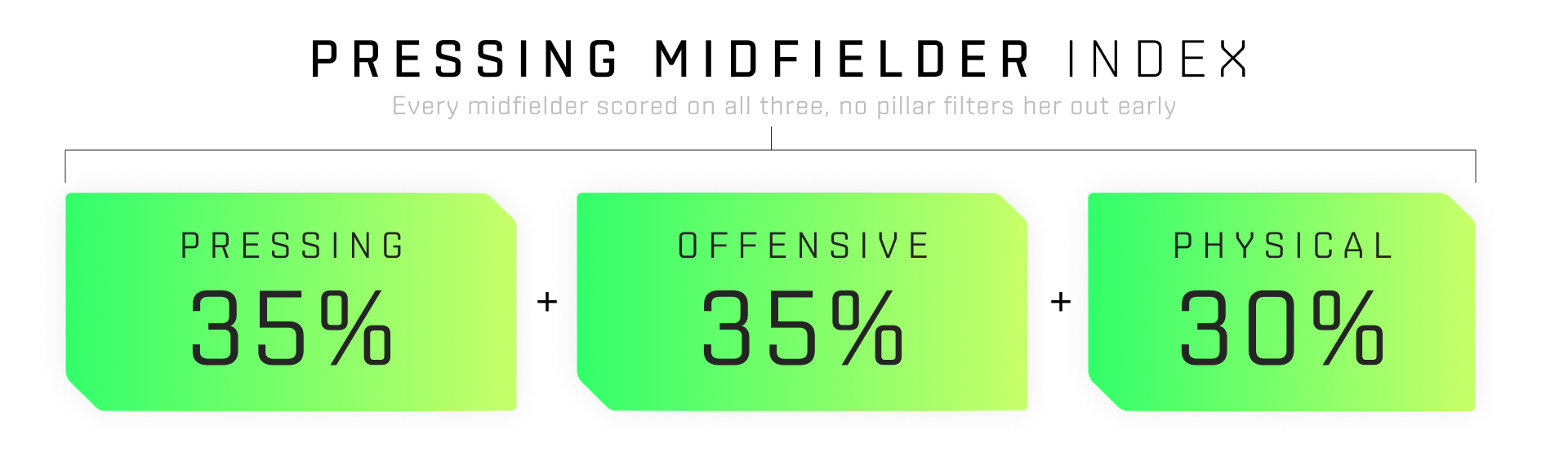
If we run every midfielder in the sample through that formula, here's who comes out on top.
The Shortlist
Some names here are the obvious ones. But others show up too, highlighting the value of a profile-based search.


Melchie Dumornay tops the index outright, and that's the least surprising part of this list: any scout already knows exactly what she offers. She was named Première Ligue Player of the Season and spearheaded Lyon's run to the Champions League final. She's tied to the club through 2029.
What's more interesting is those who follow her.
Josefine Funch is second, having won the Danish title in her first season at FC Nordsjælland. She's already moved on, joining PSV back in February. Meanwhile, Géraldine Reuteler, third, left Eintracht Frankfurt for Arsenal this summer after eight years at the club.
The real surprise for attentive readers is in fourth, where Eintracht Frankfurt’s Ereleta Memeti appears despite not warranting a mention during our analysis of any of the contributing pillars. The Kosovo international is simply comfortably above average on all three.
Just below her, Mille Gejl of HB Køge, only returned to Danish football last summer after several years abroad (Sweden, the US, France, England), and wasted no time: club captain and HB Køge Women's Player of the Year in her first season back. She signed just a one-year deal to do it, making her the one name here anyone could realistically sign right now.
Karoline Haugland, who just won the Toppserien title with SK Brann and Anaële Le Moguédec, who arrived at Paris FC from Stade de Reims last summer on a three-year deal take the next two spots ahead of Pernille Harder, another name any follower of the women’s game already knows.
Further down, Signe Baattrup is one to watch. She had the best Physical and Offensive profile in the entire sample, with only a comparatively modest Pressing contribution keeping her out of the top 10. She's also still there to be had: she signed an extension with AGF through the end of 2026, so she becomes a free agent again this winter.
Before concluding, a couple of questions that arose during the analysis.
Why doesn't Barcelona's midfield rank higher?
Barcelona's midfield trio are some of the most decorated players in the world, and Barcelona are a genuinely elite pressing side domestically. So why don't any of their midfielders show up near the top?
It seems to be because their pressing workload isn't spread evenly across the team. Barcelona's wide attackers and centre forwards, Ewa Pajor and Salma Paralluelo among them, press far more often in the high block than any of the midfielders do.
That isn't universal to high-pressing teams, though: at Bayern Munich, Pernille Harder ranks highly no matter which position she's playing. As a midfielder, she presses as much as or more than some of the centre forwards, and more than she does herself when she plays up front.
Why did Grace Geyoro not appear?
Grace Geyoro's name comes up naturally here as she has reputation as an elite, high-pressing box-to-box midfielder. But her first season in England came with a real physical catch-up; manager Jocelyn Précheur stated that after a long break following Euro 2025, "she needed to start conditioning from scratch," and it could take months for her to be fully up to speed.
That shows up in the index: she ranked considerably higher in her final two PSG seasons than she did last season. Even then, though, Pressing specifically was never her standout pillar; it's her attacking output that's taken the bigger hit this season, not a pressing profile that was already modest to begin with.
Contextual Scouting: From Data to Decision
We set out to build one specific profile: a No. 8 for a club whose identity is forged around pressing high.
Running every midfielder in the sample through the resulting Index did exactly what a proper scouting process should: it confirmed the obvious names, surfaced others a highlight reel would miss and raised genuine caveats worth taking into consideration.
The end result was confirmation of the value of a data-driven approach: not to identify the best No. 8 out there, but the best one for this team, right now.
.webp)