


Shot Quality, Reframing Shots Through Tracking
Evaluating the opportunity rather than the outcome

Shot Quality, Reframing Shots Through Tracking
Our 10 years of experience building the leading AI-powered tracking technology has opened up endless opportunities for leveraging data and gaining powerful insights into basketball. Introducing: Shot Quality, our latest model created using our knowledge and expertise.
Shot quality grades every shot by how likely it was to go in: a wide-open layup scores high, a contested step-back three scores low. This allows analysts and coaches to judge a team or a player on the looks they create, not just the ones that drop.
What Does Shot Quality Measure?
Shot Quality answers the question every basketball fan wonders: How good was this shot opportunity, regardless of the outcome ?
Traditional box scores only record the outcome. A wide-open layup that hits the rim is counted as a miss, a heavily contested 3 point fadeaway that goes in counts as a make. That’s it. Aggregate these events throughout the course of a game and suddenly the line between luck and talent starts to blur and makes it difficult to see how well a team actually created chances.
Shot quality separates these two factors. Instead of focusing on the outcome it focuses on the look itself (the shot location, the defensive pressure when the shot was taken) so you can unscramble these factors and turn them into questions:
- Did the team create good shot opportunities? That’s shot quality.
- Did the shooter convert these shots better or worse than expected? That’s shot-making.
How Does Shot Quality Work?
Shot Quality is a predictive model, it may only use what is known before the ball has left the shooter’s hands. If it were to see what happened after the release it would partially see the outcome and therefore its probability measurement would end up being biased. The model inputs the tracking data five seconds leading up to the shot and outputs the probability that the shot will go in. It learns from the data instead of following hand-written rules.
Let’s break it down:
- Our single feed tracking gives the model the X/Y position of every player on the court, frame by frame. The model tracks the shooter. It doesn’t use video or box score stats.
- The model uses a neural network to learn which configurations lead to makes. No one manually defines the thresholds.
- The model outputs a calibrated probability. We validate it against real outcomes: predicted rates have to match real make rates. If the model says 45% for a group of shots, about 45% of them go in.
An Example Of What Shot Quality Can Show
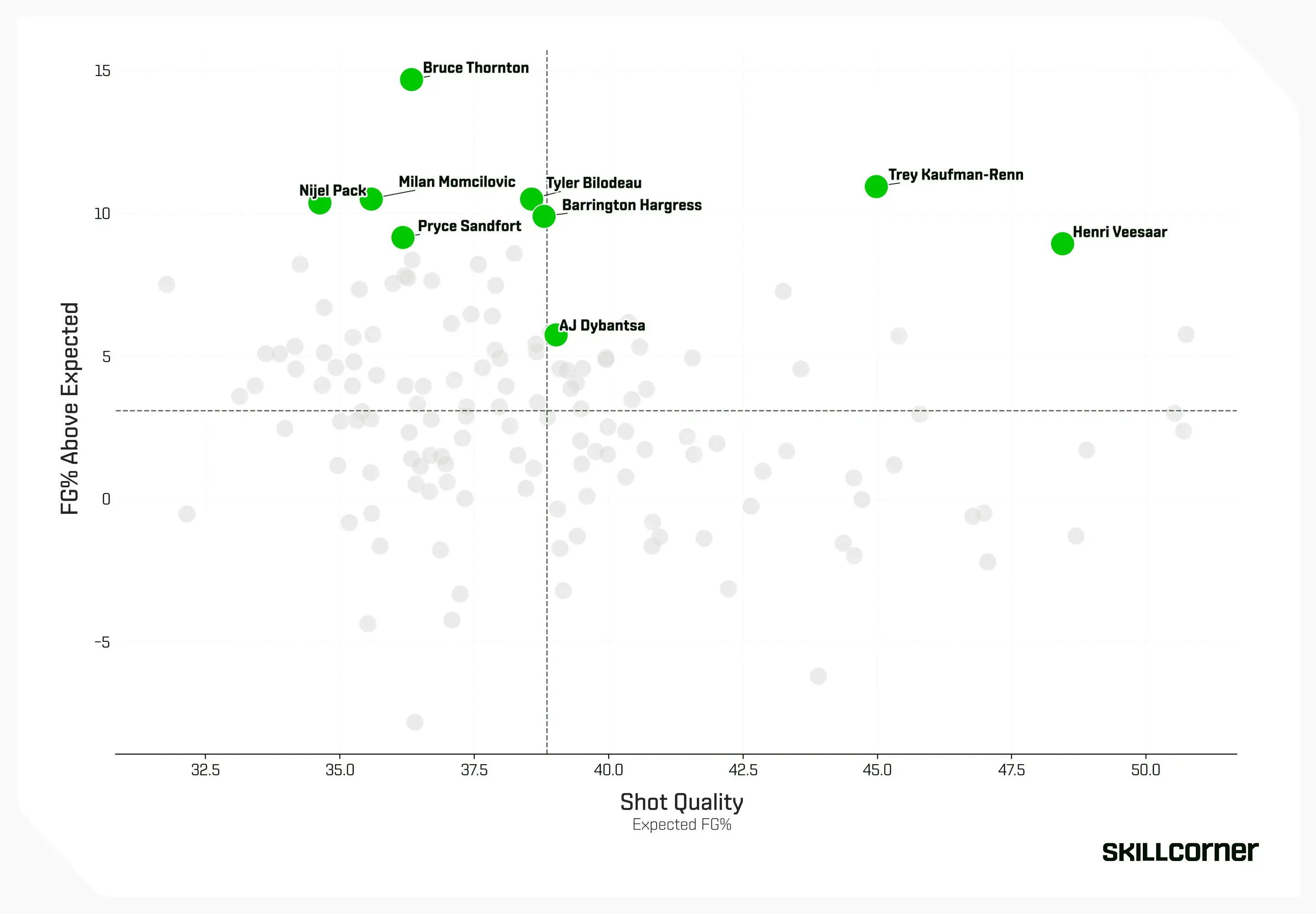
Shot Quality gives every attempt a probability of going in. Averaging it across a player’s field-goal attempts gives his expected FG%: the percentage an average shooter would make on the same shots. Comparing it with his actual FG% gives his FG% above expected, a measure of shot-making. As in the box score, missed shots on which the shooter was fouled are not counted as attempts.
What Our Experts Think About Shot Quality
Shot Quality may be a model, but behind the machine lies a human expertise and the hearts of people who live and breathe basketball. Who better than the minds behind the model to explain the true potential of Shot Quality.

First of all, we've broken down how the calculations work, but what was the logic behind it?
Azad: Shot Quality used to be something only NBA teams could measure and analyse. The goal was to bring this to all teams, be it in the NCAA or FIBA competitions.
Let’s go a bit more in depth on how Shot Quality works. Why does the model not take into account the shooter?
Francesco: By design we don’t want to take into account the shooter, we want to score the look and its quality. If we were to identify the shooter we would lose the insight on what led to the look as the outcome would be biased by the shot making skills of the shooter. It would prevent analysts and coaches from learning if their process/decision-making made the opportunity possible. It would give you a false insight on a play and sometimes send you in the wrong direction when it comes to how your team plays.
Why watch the five seconds before the shot instead of just the moment of release?
Francesco: We do this because the play before the shot carries a lot of information the release frame does not: the drive, the cut, the timing of the help. This is the unseen work that allows a look to happen. When you’re watching a game, you often get the feeling that a team is creating a lot of scoring opportunities but you can’t always quite put your finger on why or how. That is what Shot Quality allows you to see.
What does Shot Quality reveal about the kind of shots a player takes?
Francesco: A high average Shot Quality means clean, open, close looks; a low one means contested or tough shots. This creates a shot-selection profile, independent of whether the shots went in or not.
What do you expect to see from a good shooter versus a bad one when using Shot Quality?
Francesco: The same expected points for the same looks, but a good shooter scores above expectation and a bad one below. The gap between actual and expected points allows us to see a player’s shooting-skill.
We’ve been talking a lot about the offensive insights Shot Quality offers. But what about defensive insights? Can you measure a defense by the quality of the shots it allows?
Francesco: Yes. Every shot has a Shot Quality value whichever side you read it from, so a team, a player or a zone can be rated by the looks it concedes, not only by the makes.
We’ve seen how the model works and the insights seem endless, what are some of those you think are a true game changer in basketball analysis?
Azad: Shot Quality gives teams the ability to truly evaluate a player's influence on so many levels. What is his impact on his team or the opposing team’s shot quality? Can he make a tough shot? Is he over-performing or under-performing? The insights are multiple and applicable to the NBA, the NCAA or even the FIBA competitions, that’s the real game changer: giving access to these insights to all teams across the world.
In one sentence, what does Shot Quality tell a coach that the box score can’t?
Azad: As mentioned previously, Shot Quality evaluates a process rather than an outcome. This means that coaches can see if the win/loss is due to variance or decision making. This is a huge insight that allows you to pivot quickly when you are averaging 2-3 games a week.
Many college programs have a small analytics staff. What's the one report from the Shot Quality model they should start with?
Azad: In my opinion, staff should prioritize reports that evaluate the outcomes vs their process. When you play 2 games a week it’s important to be able to quickly identify what’s working and what’s not. In the highly competitive college landscape this can give you an edge on your competition and bring you closer to that March Madness all teams are striving towards.
What does Shot Quality bring to a team beyond in-house insights?
Azad: Our solution offers worldwide coverage across all basketball divisions. You can apply Shot Quality to 19+ competitions for scouts to find the perfect fit/addition to your roster much more easily and effectively.
Anything else you want to add?
Francesco: We are preparing a very interesting analysis using Shot Quality so stay on the lookout for our Shot Quality Series!
Go Further With SkillCorner
If you want to learn more about our Shot Quality model, reach out today.