


Leaving to Grow: Italy's Young Attackers Abroad
Italy’s young attackers are leaving before getting significant minutes in Serie A. How do they fare abroad?

For decades, Serie A sat at the centre of the football world. Through the 1980s, 1990s and early 2000s, Italy not only drew many of the game's best players from across the world but produced some of the very best itself, fielding talent at its peak.
Since the early 2000s, alongside wider changes in capital, infrastructure and management, the pattern has gradually shifted.
Even so, young players still tend to take a longer route to the top of the Italian pyramid than their counterparts elsewhere, often moving out on loan or to lower-league sides, sometimes more than once, before reaching Serie A.
This has given rise to two new trends. First, the national team, once a stage for established names at the height of their careers, has in recent years increasingly become a place to introduce young talent. During his first stint as Italy's head coach (2018–2023), Roberto Mancini — now back in the role — was among the first to call up young technical players such as Nicolò Zaniolo and a 16-year-old Simone Pafundi, summing up the approach in a now-famous line: "Pafundi first, then all the rest."
Second, young players now go abroad having barely played a minute in the Italian top flight, before eventually returning home or establishing themselves on the continental stage.
In Search of Opportunities Abroad
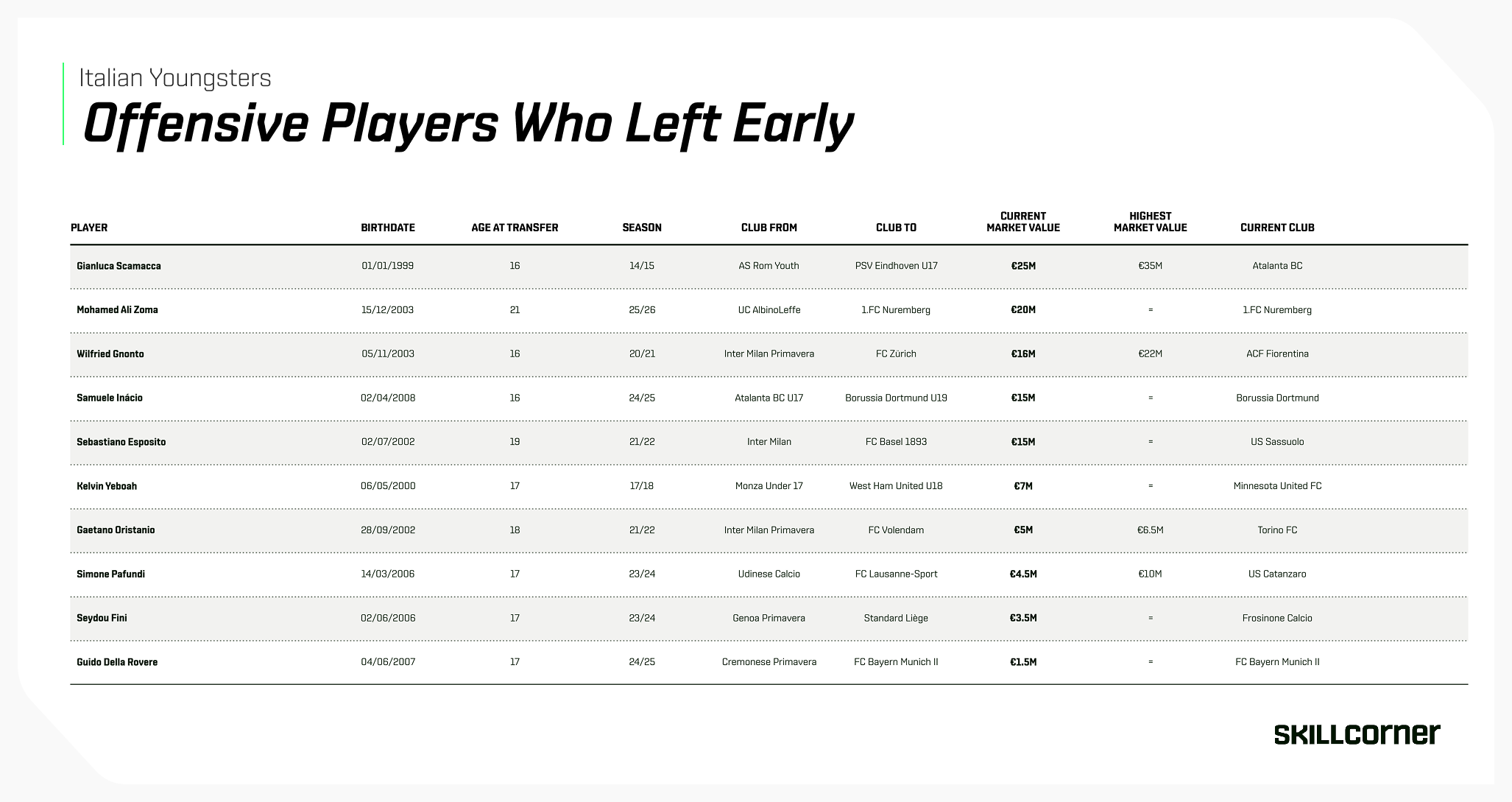
While the departure of centre-backs – the likes of Riccardo Calafiori, Luca Reggiani, Filippo Mane and Andrea Natali – is a more recent and limited trend, young attackers have been leaving Italy at a steadier pace for some time, and doing so before collecting any meaningful senior minutes in Serie A.
Pafundi is the player who accumulated the most before his move to Switzerland, but even he only saw less than 150 minutes of playing time at Udinese across the 2022/23 and 2023/24 seasons. Behind him stretches a relatively long line of players who left and went on to reach significant market value over their careers; ahead of him are a newer wave of departing youngsters.
Physicality in a New Environment
In a previous piece, we showed how offensive players can be profiled by their most characteristic physical traits: volume, intensity, explosiveness, or some combination of the three.
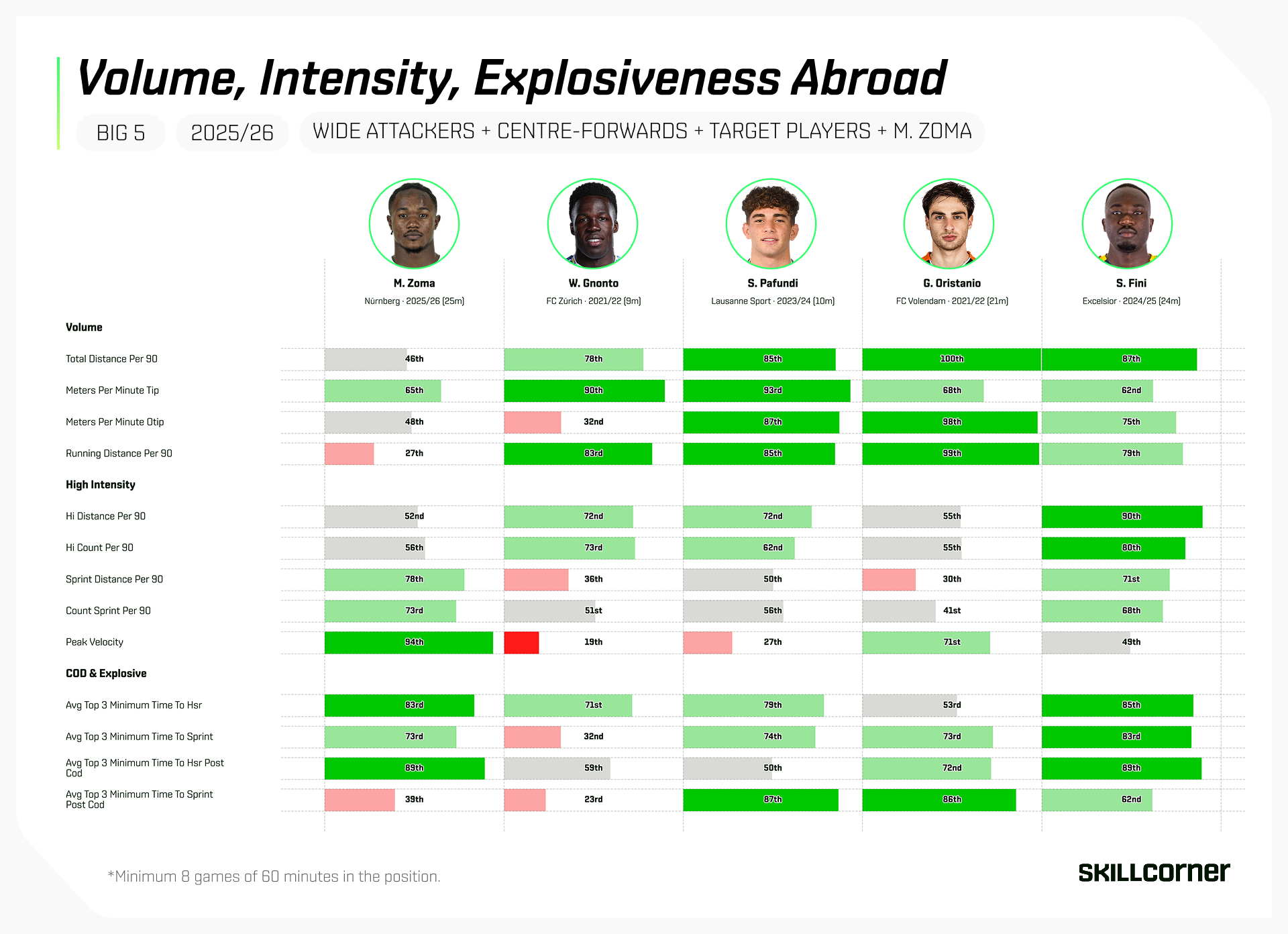
Take this group of attackers who left Italy with almost no Serie A minutes, and one thing stands out immediately: their physical output in the first full season outside of the country stands comparison with elite wide attackers and centre forwards across the Big 5 leagues.
Mohamed Alì Zoma excels in Peak Velocity and explosiveness; Seydou Fini profiles as a pure physical talent; Simone Pafundi and Gaetano Oristanio lead on volume.
Mohamed Alì Zoma: From the 2. Bundesliga to the National Team
Zoma is one of those young Italians who left early. He has caught the eye at Nürnberg this season, two years on from a move that took him from Italy's Serie C, the third tier, to Germany’s 2. Bundesliga. But should it really be a surprise?
The physical data already indicated he had something about him. In his final season at AlbinoLeffe, Zoma ranked strongly for intensity…
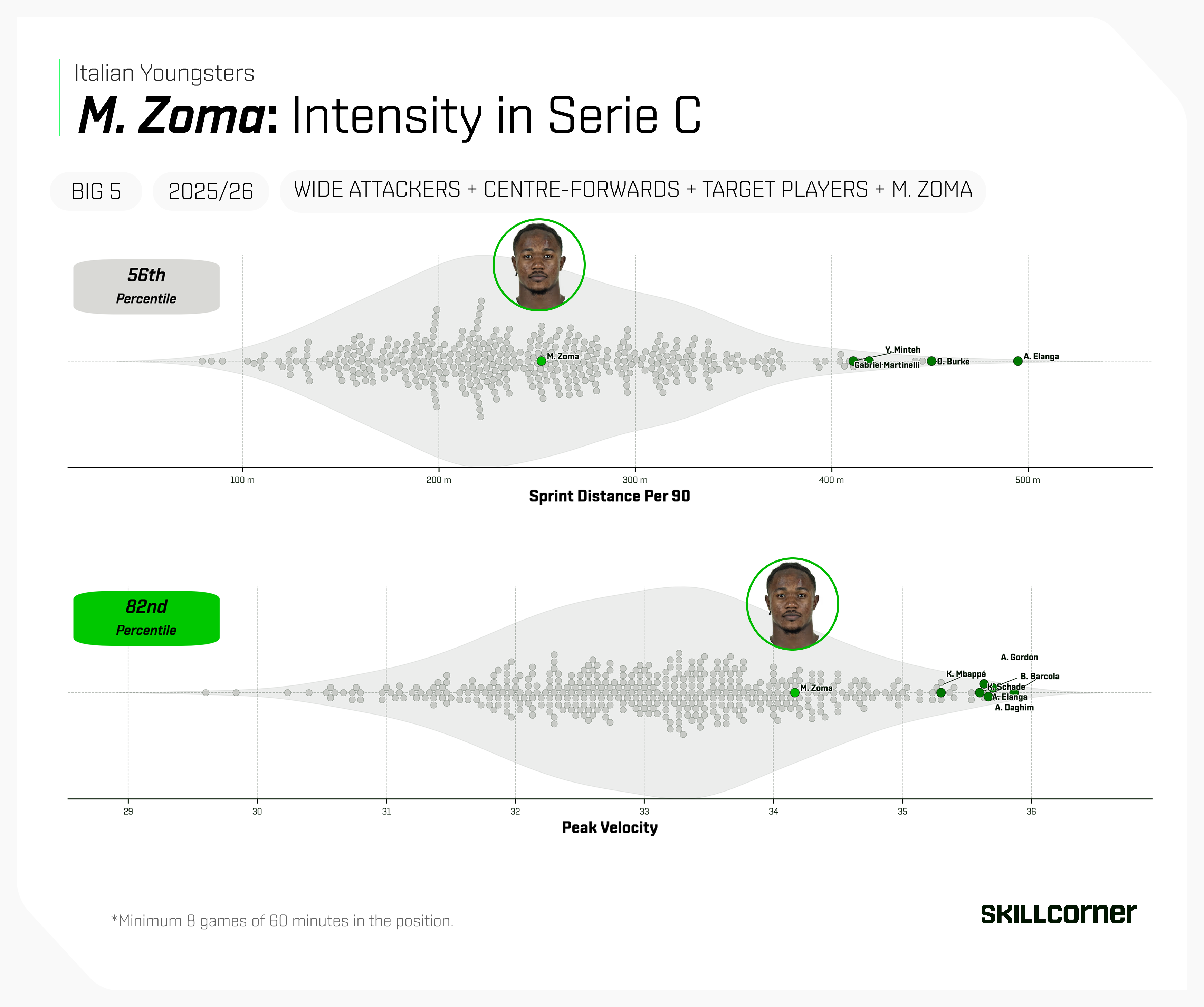
…and explosiveness, even when compared against elite players from the most competitive European leagues.

Those two qualities are part of what sets him apart. A third, more technical and tactical, is his ability to create an advantage — for himself and for the team — out of 1v1 situations, something he was already doing in the lower reaches of Italian football.
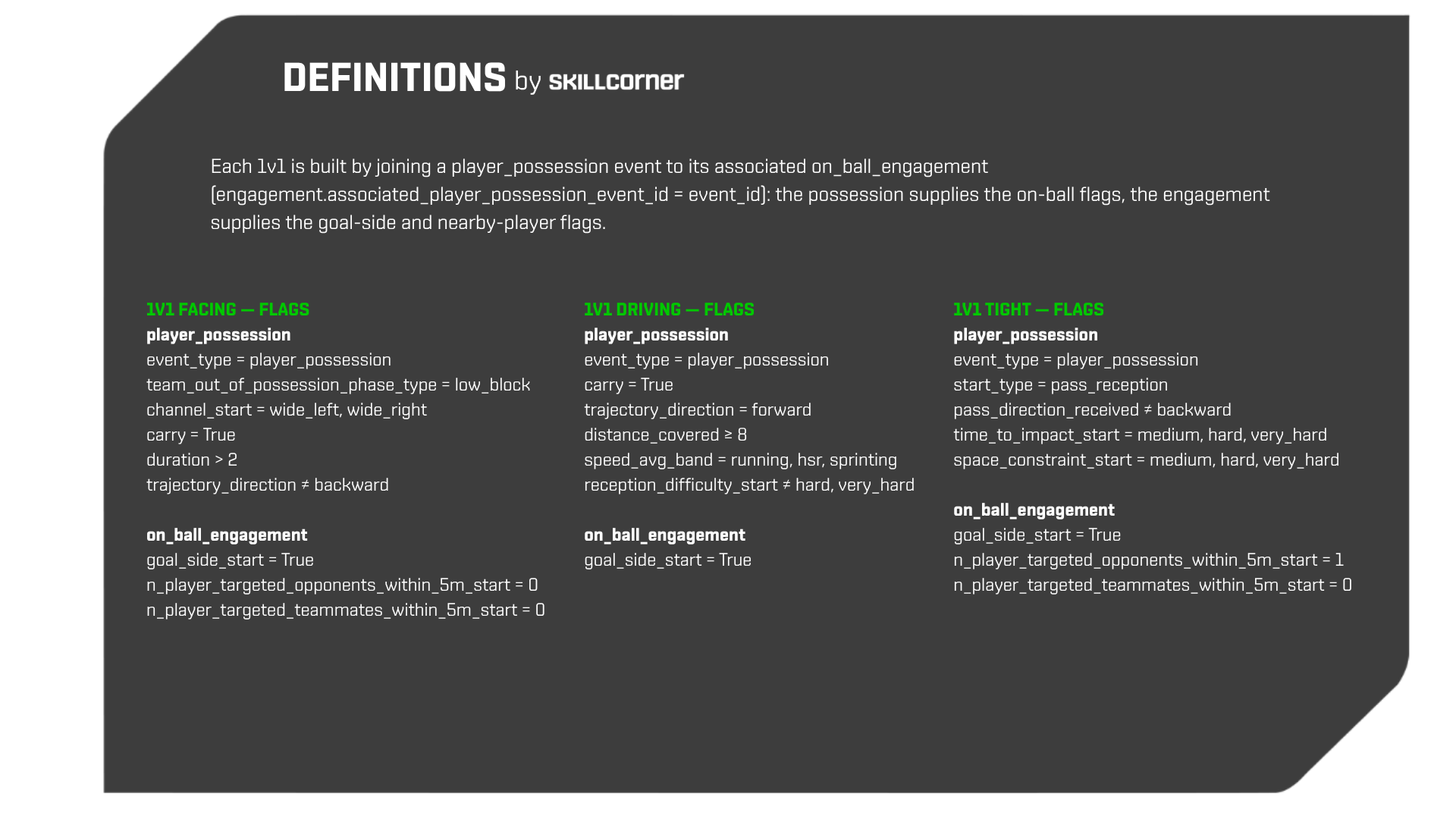
With SkillCorner's Dynamic Events, we can isolate and quantify different types of 1v1s and measure a player's effectiveness in each.
For this analysis, we count a 1v1 as won when the attacker beats his direct opponent, or wins the goal side through his action, starting from a wider position. The flexibility of Dynamic Events, however, allows clubs and analysts to set their own criteria for what is considered "success."
In Zoma’s case, while putting a precise coefficient of difficulty on a move between international leagues remains hard, we can see that his output across three different types of 1v1 situations held steady between his final Serie C season and his first year in the 2. Bundesliga.
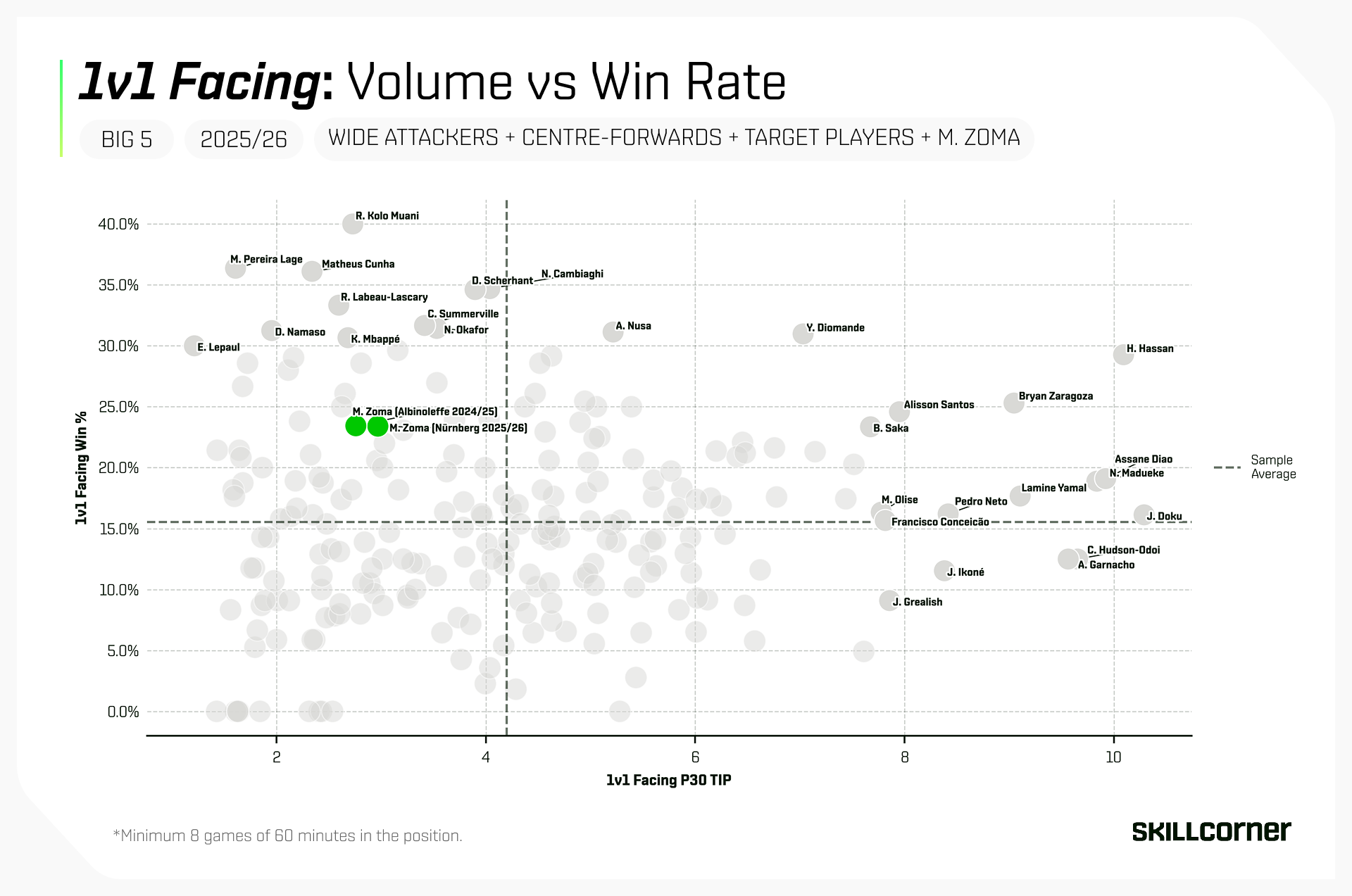
1v1 Facing
Facing is about beating a set defender through close control in a specific context: a wide channel, against a low block, isolated.
Zoma looks effective at taking on defenders in a low block. Yan Diomande and Antonio Nusa are among the strongest in the sample.
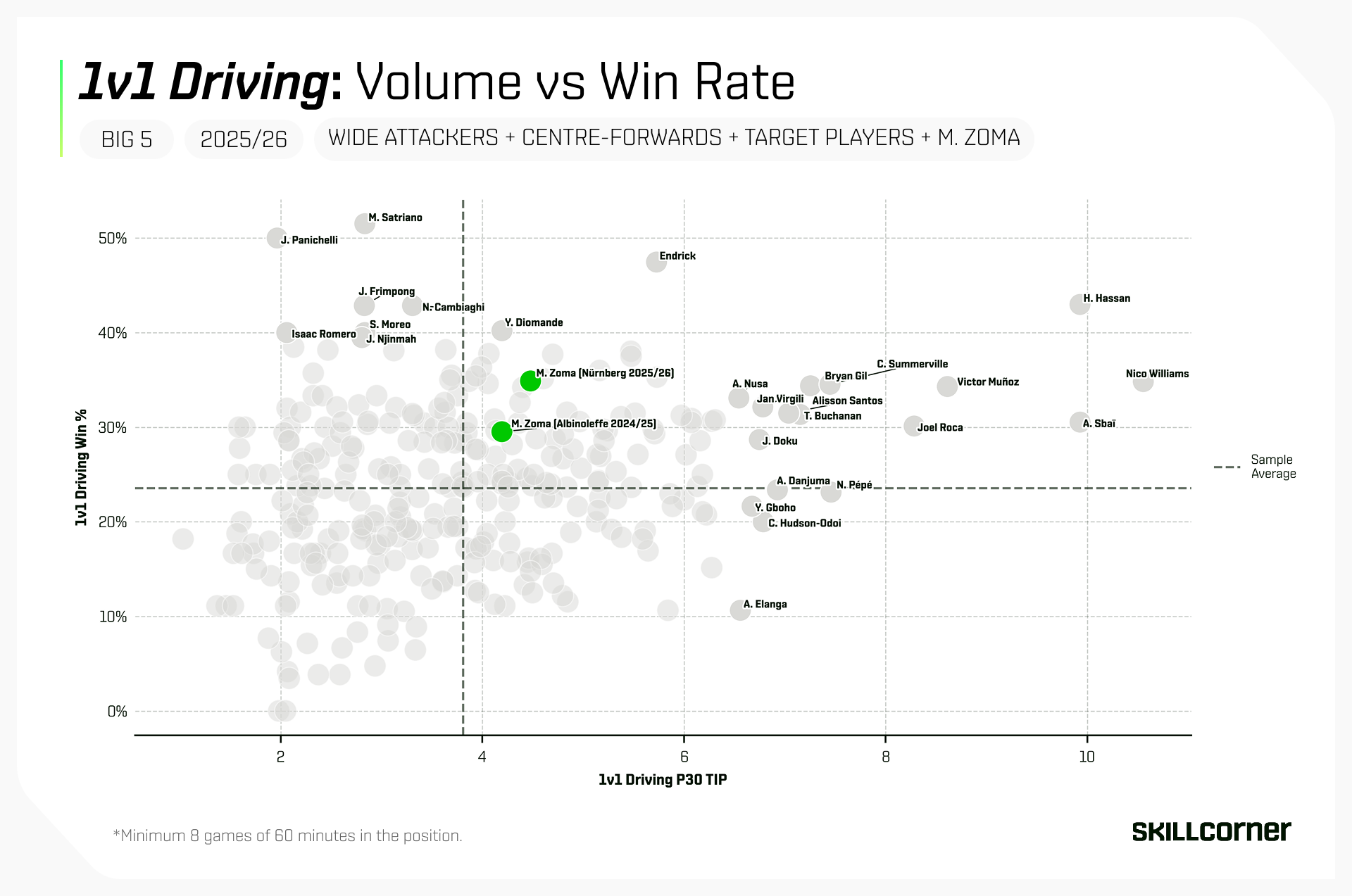
1v1 Driving
Driving describes beating a defender through pace, covering ground quickly, regardless of phase or location on the pitch.
Here, Zoma sits above average for both volume and effectiveness, beating opponents through his athleticism, exactly as he did in Italy. Nico Williams and Crysencio Summerville are among the standouts.
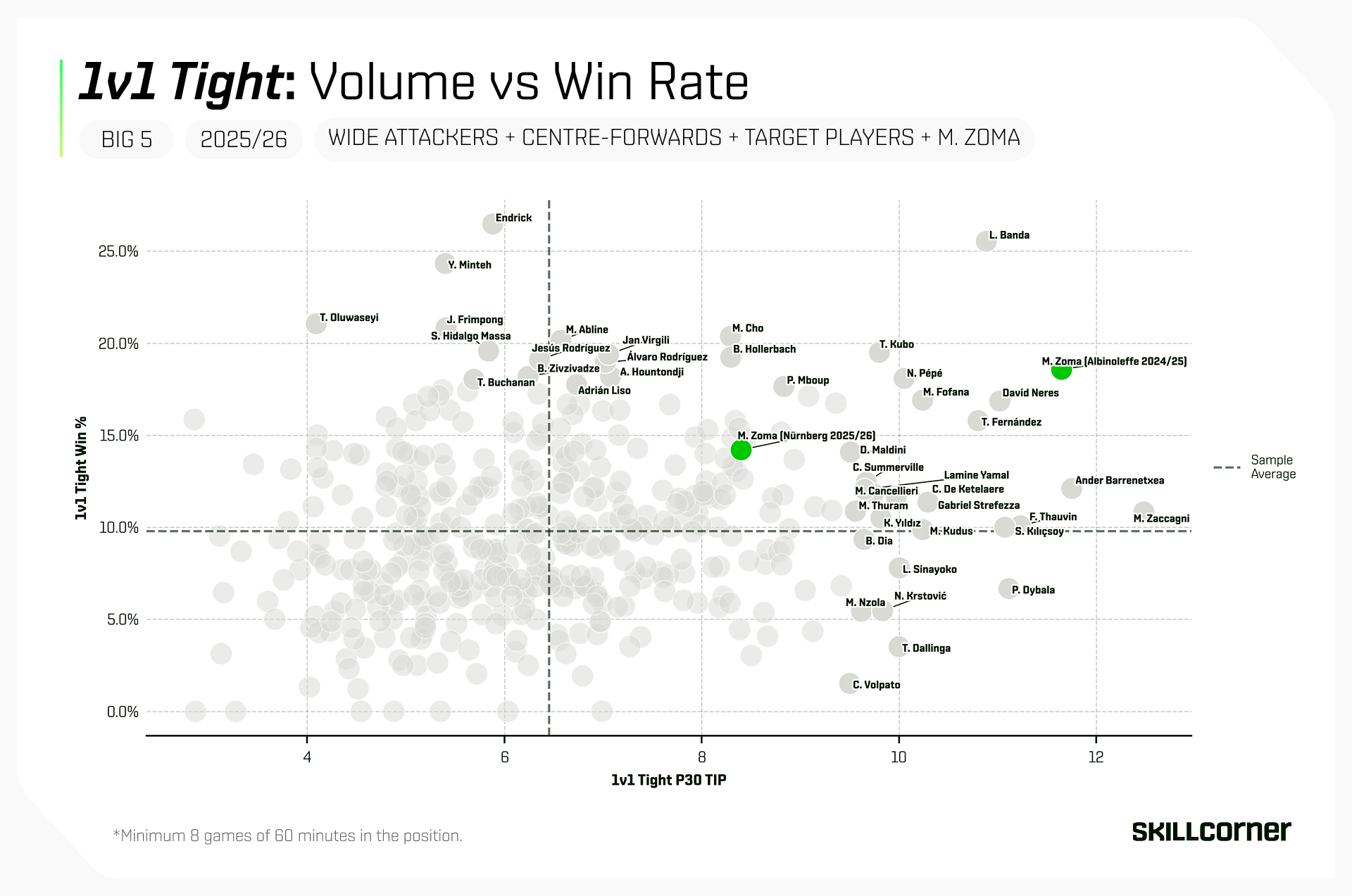
1v1 Tight
Tight covers beating a defender who closes in as the ball arrives, winning the duel under immediate pressure rather than through isolation or a run at pace.
Zoma again rates highly here in terms of both volume and success rate. Malick Fofana and Takefusa Kubo are among those who excel.
Adding Value in Possession
Those readings on Zoma’s 1v1 play are reinforced when we turn to the value he brings to his team in terms of his impact on their probability of scoring. Through SkillCorner's Expected Possession Value (EPV), we can quickly separate the players who create value by carrying the ball from those who do it by passing.
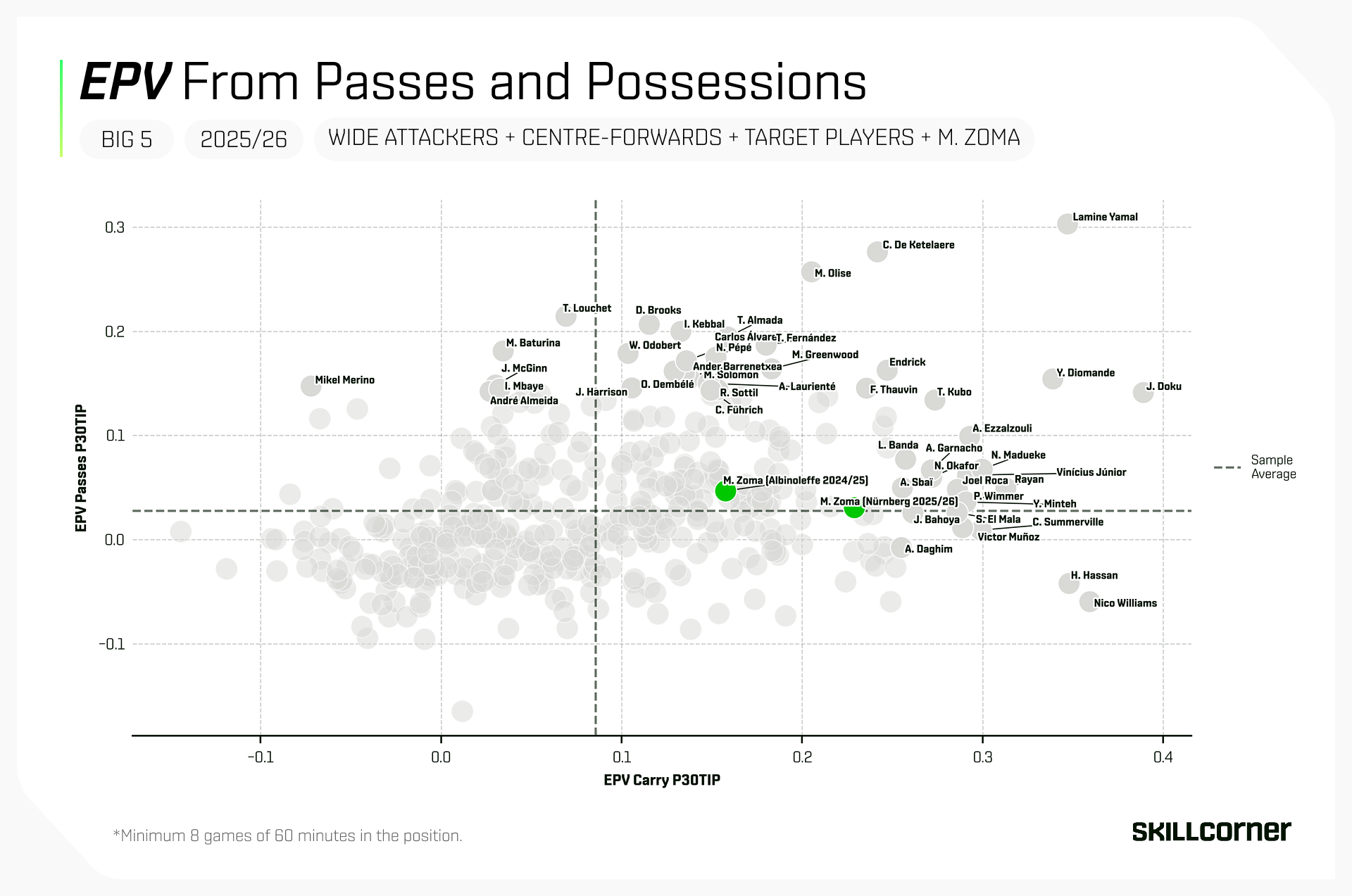
In both environments, Zoma adds significant value from carries, further substantiating the physical and technical qualities that make him such an effective 1v1 operator. But it is also worth noting that he is a marginally above average contributor from passes.
Where to Look Next
Zoma is one example of a wider trend. With Italy's young players increasingly developing outside Serie A, the country's lower and youth leagues have become a market worth watching for talent who can be signed early, before they reach top-flight prices.
SkillCorner data enables clubs to measure physical, technical and tactical output across those divisions and spot the players ready to move up ahead of the competition.
Unlock the real value of tracking data. Get in touch to learn more about Game Intelligence and our Physical Data.
.webp)