

How to Spot Elite Talent Before Their Price Explodes
Balancing multi-season performance confidence against rising transfer market values.
Everyone can look at Morgan Rogers now and see a player capable of delivering consistent impact in the most competitive environment in world football. But what is the best way to spot the next Morgan Rogers early, before their market value becomes prohibitive for most clubs? And when could we have projected that he was going to become a success?
While there is no sure-fire way to predict a signing’s future performance, our data shows a clear link between consistency over consecutive seasons and future impact. Crucially, however, this same data highlights that a player’s market value increases hand in hand with that consistency. What remains for clubs, then, is a balancing act between observation time and level of investment.
When did we know Morgan Rogers was good?
When Morgan Rogers completed his £117m move to Chelsea, he became the most expensive English player in history. Yet not too long ago, he was available at a fraction of that cost.
Rogers is a great example of a player climbing every step of the football pyramid while leaving a trail of underlying metrics that pointed toward elite potential well before his breakthrough, across different scenarios, leagues and team environments.
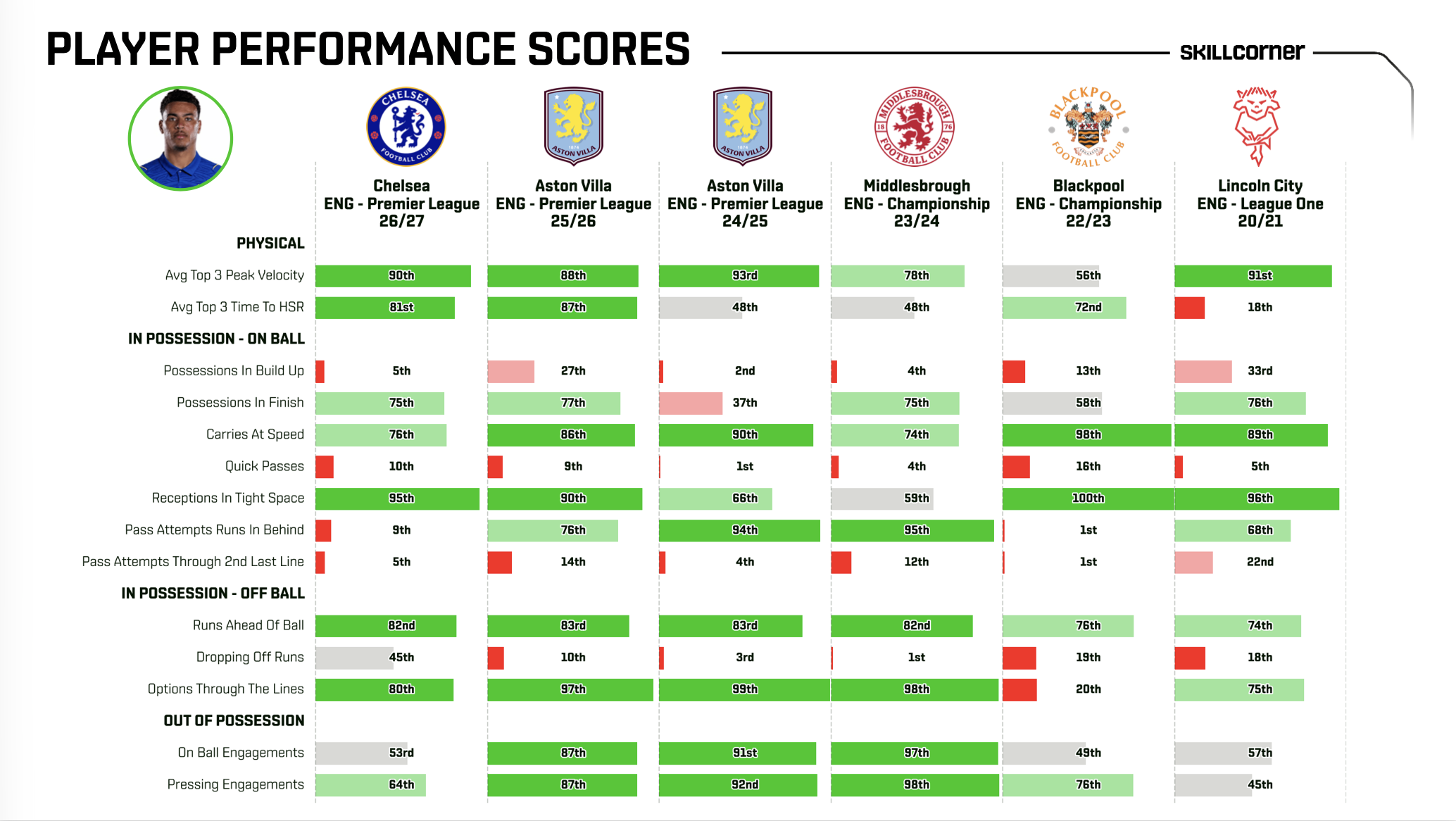
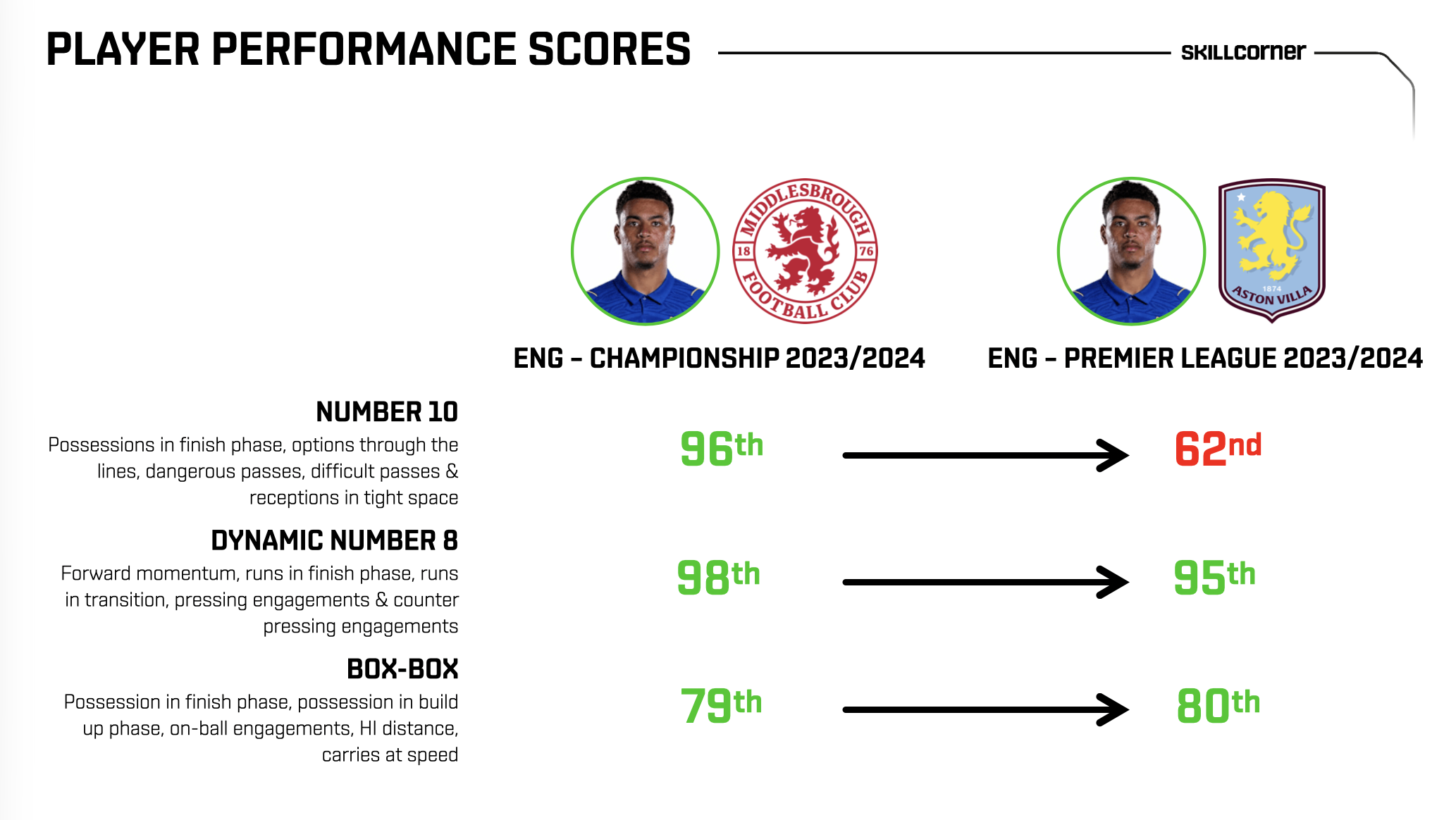
Looking back, his core markers like carries at speed, receptions in tight space, options through the lines and runs ahead of the ball were already showing. Importantly, benchmarking him across three prominent midfield roles, he maintained nearly the same level in two of them (Dynamic Number 8 and Box-to-Box) after moving from the Championship with Middlesbrough to the Premier League with Aston Villa.
Rogers’ rise in profile and value isn’t unique. It’s a familiar story, one we’ve seen play out with the likes of Moisés Caicedo, Yan Diomandé, and Khvicha Kvaratskhelia. Cases like these highlight a fundamental challenge for clubs: predicting early enough just how high a player’s ceiling might be, while striking the right balance between confidence in their future output and the required level of investment.
The single-season hype risk
By analysing over 31,000 transfers across our eight-year database, we examined player performance both before and after a move. Specifically, we mapped the trajectory of players who performed in the top 20th percentile for their position and role in the season immediately prior to transferring.
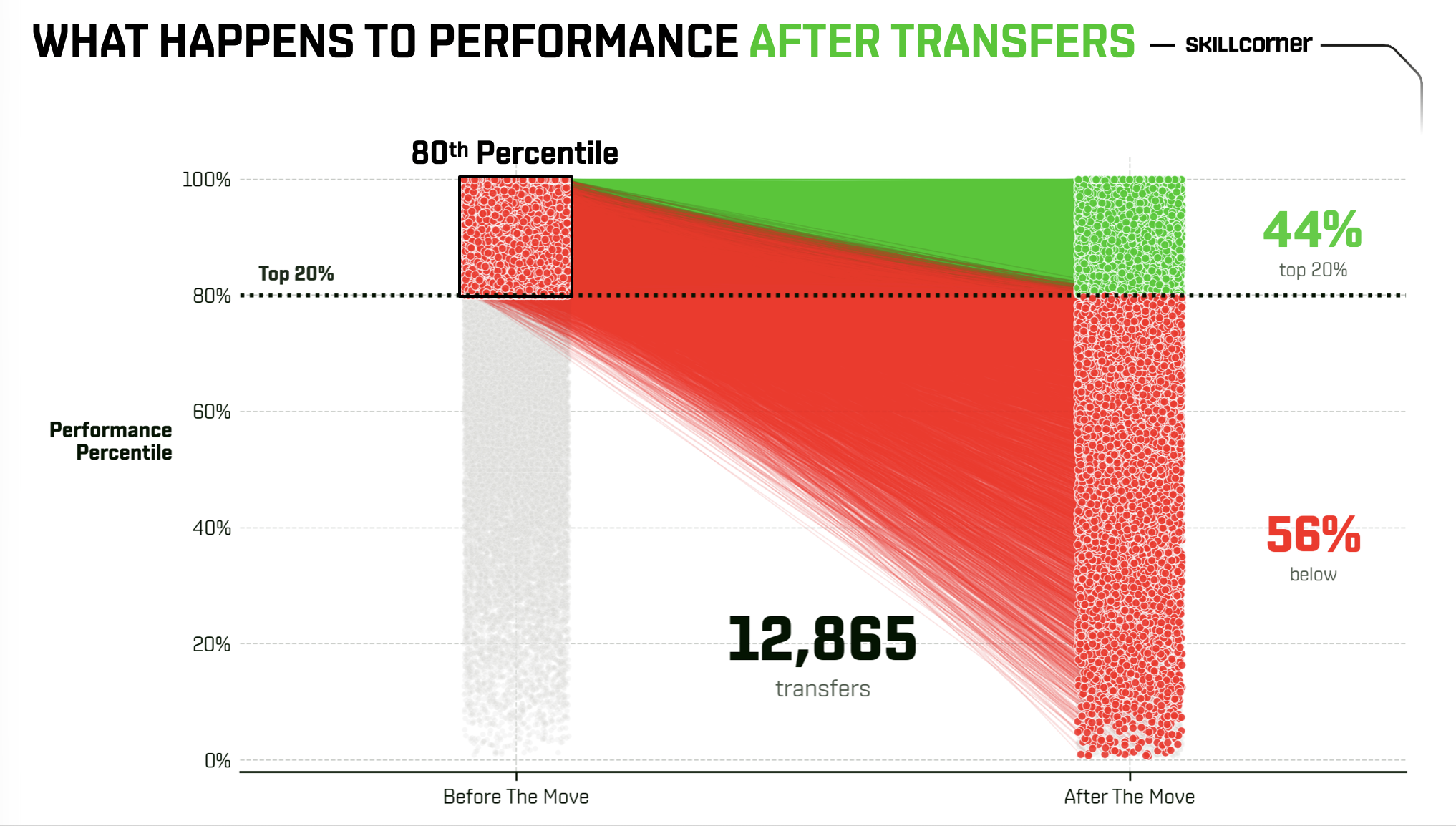
Less than half of them (44%) managed to remain in the top 20th percentile the following season. Factors such as team style, managerial impact, teammate quality, individual form, and league quality and style can all contribute to this drop-off.
Looking at higher-ranked players, such as those in the top 10%, 5%, and 1%, the predictability of sustained performance did increase slightly. But relying strictly on those tiers leaves recruitment teams with an exceptionally small shortlist of names, all of whom are well out of reach for most clubs.
What, then, is the solution to gain some degree of certainty around a player’s true level and what they can deliver?
Consistency as a predictor of future performance
To find the answer, we looked at the impact of a proven track record across consecutive high-performing seasons on our ability to confidently predict a new signing’s future output.
Using our sample of over 31,000 transfers over eight years, we tracked how staying in the top 20th percentile for a given position over multiple consecutive seasons translated into success the following year (defined as remaining in that top 20th percentile).
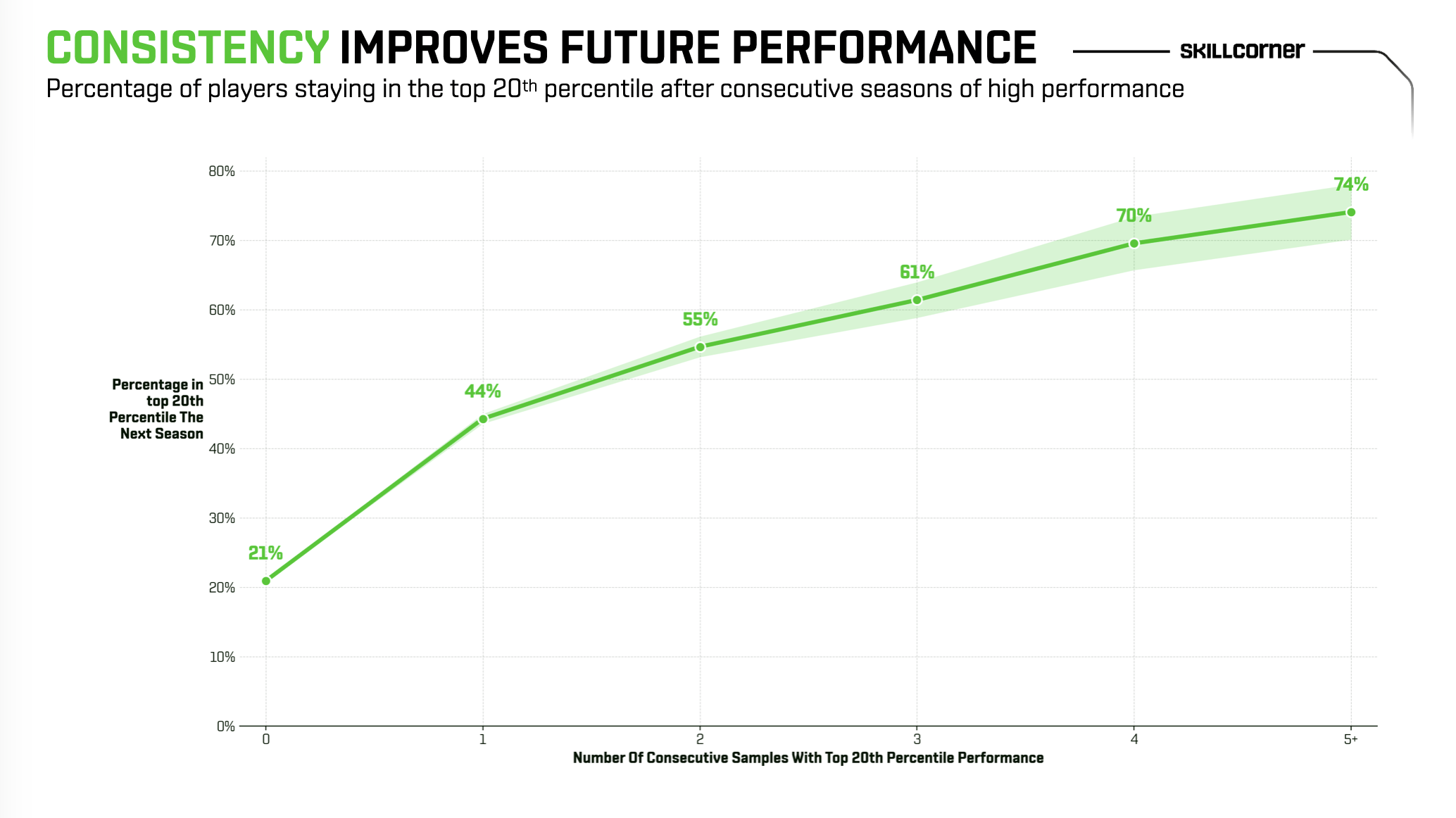
- 1 strong season 44% chance of remaining in the top 20%
- 3 consecutive strong seasons 61% chance
- 5+ consecutive strong seasons 74% chance
The obvious caveat here is that after multiple consecutive seasons among the league’s top performers, a player’s quality is no secret – and their market valuation reflects it. After four continuous seasons of elite output, a player’s market value is roughly 2x higher than that of an average player of the same age in their league.
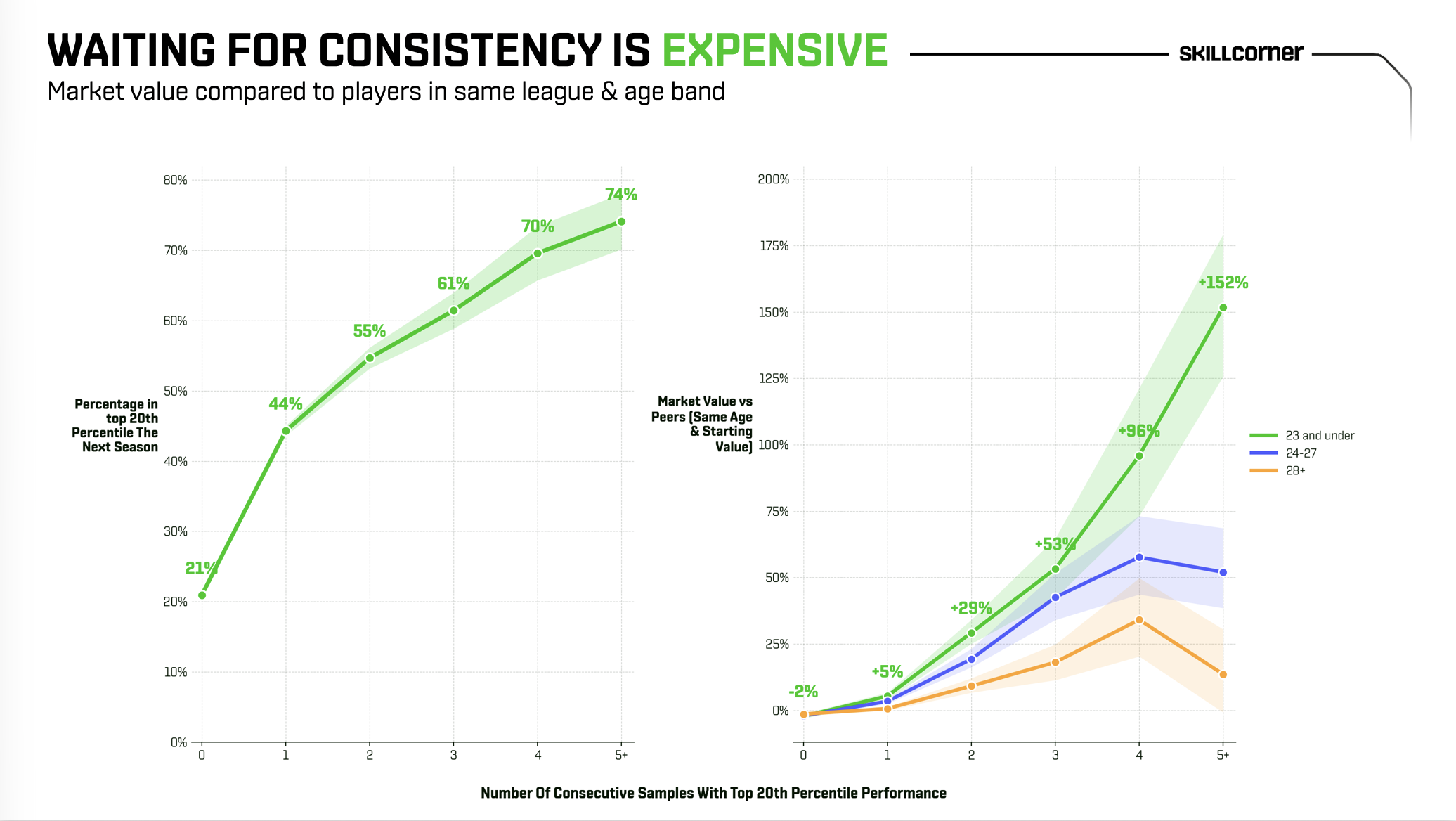
Waiting that long isn't an option for most teams, making it increasingly necessary to establish decision-making frameworks aligned to risk appetite and budget.
Performance Confidence Model: A case study
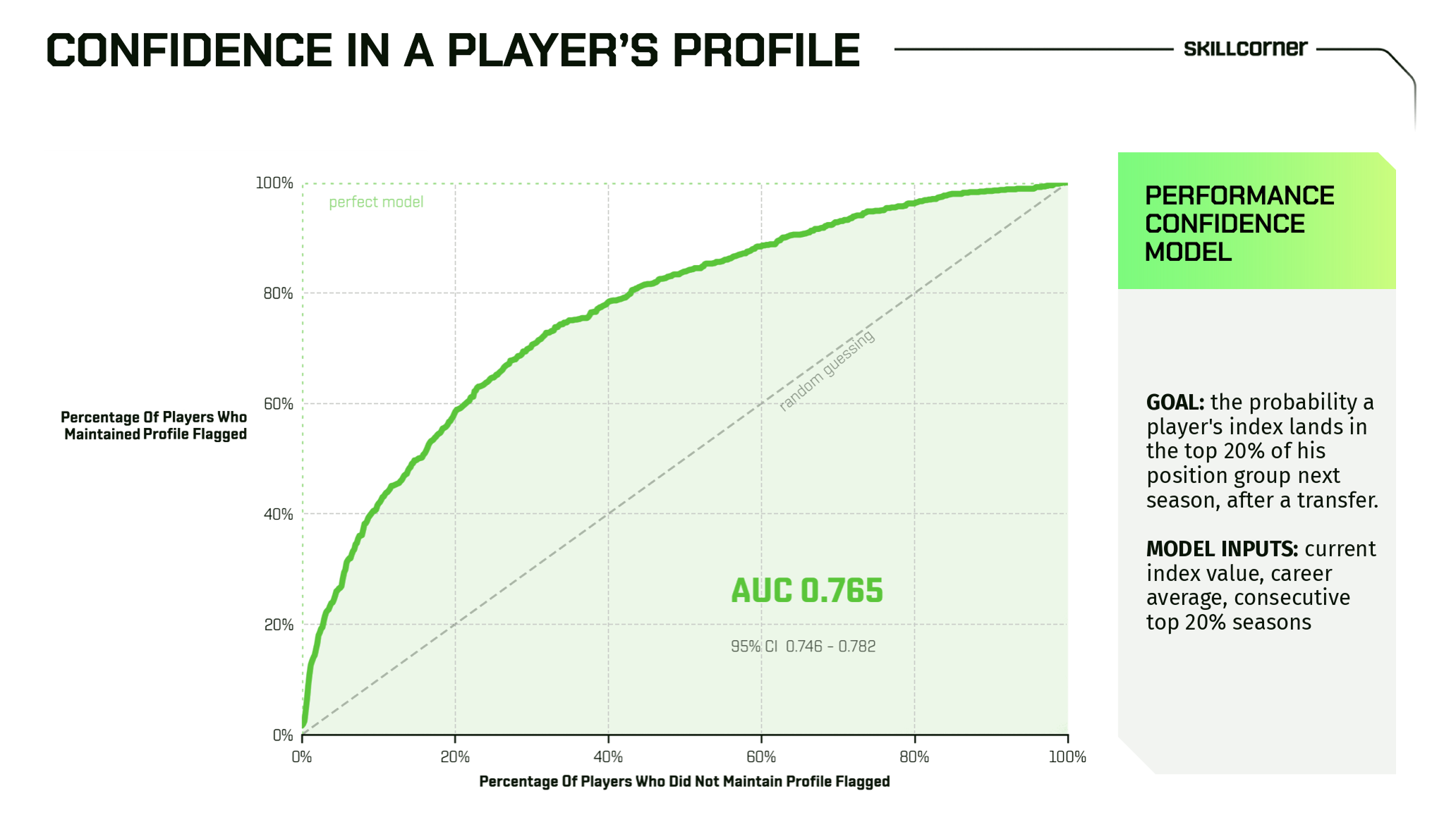
We can't look into the future to be certain of a signing's future performance, but what we can do is build an approximation to answer whether a signing is likely to succeed. To achieve this, we developed a proof-of-concept predictive model to estimate the likelihood of a top 20% player remaining in that top-ranked group post-transfer.
The model factors in their current performance ratings, their career average, and the number of consecutive seasons spent in the top 20th percentile. The model isn't magic, but it provides a far more reliable baseline than intuition alone or single-season data.
Applying this model to a sample of central and attacking midfielders under the age of 25 across the top five leagues in the 2025/26 season yields the following chart:
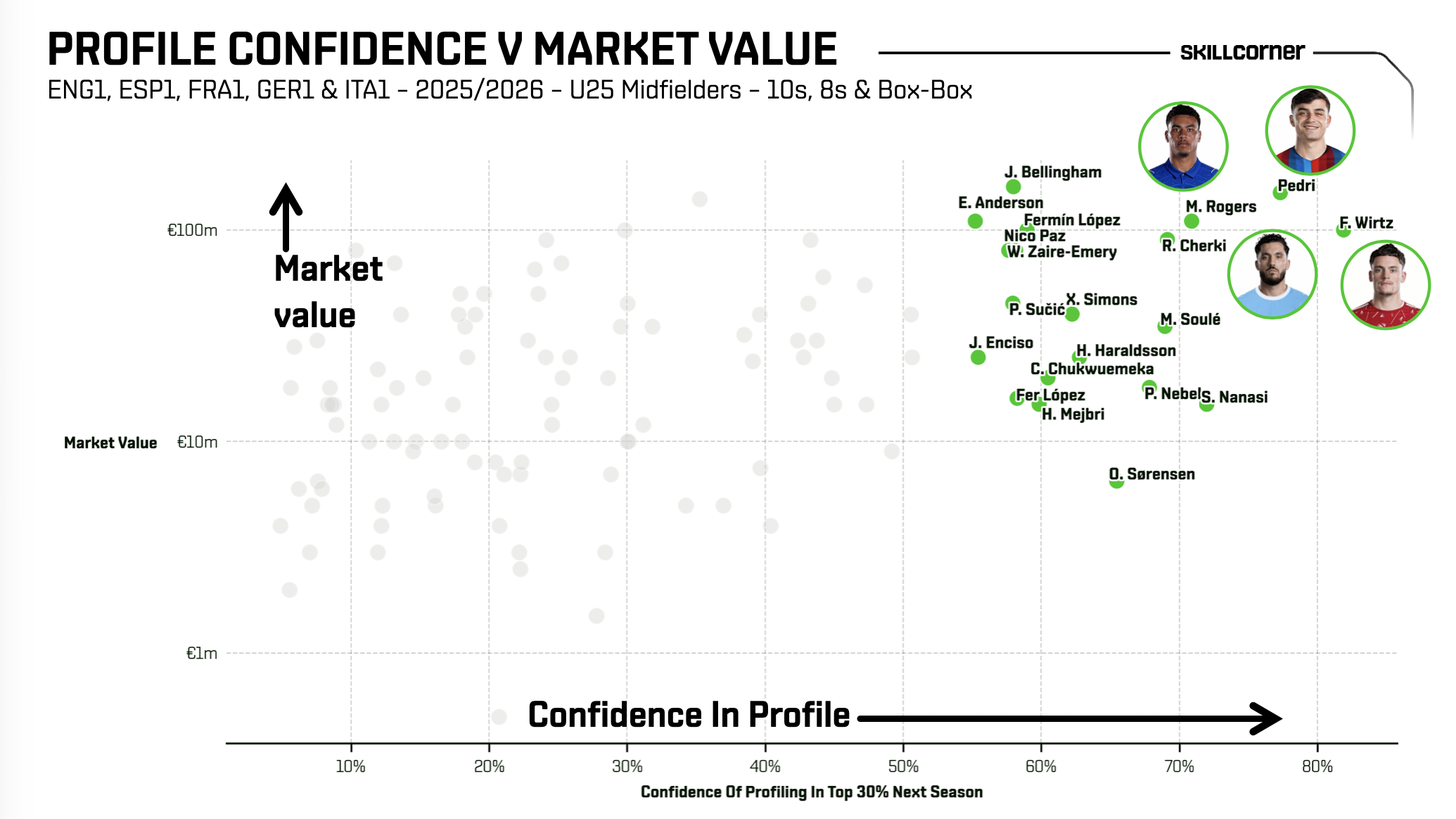
In the top-right corner, at the intersection of high confidence and high market value, we naturally find household names like Pedri, Morgan Rogers, Florian Wirtz and Rayan Cherki. But unless a club has £200 million ready to fork out, these are players out of reach.The solution, then, is to move more towards the middle of that scatter plot. There, we begin to see players who carry lower future performance confidence, but whose market values have not yet skyrocketed.
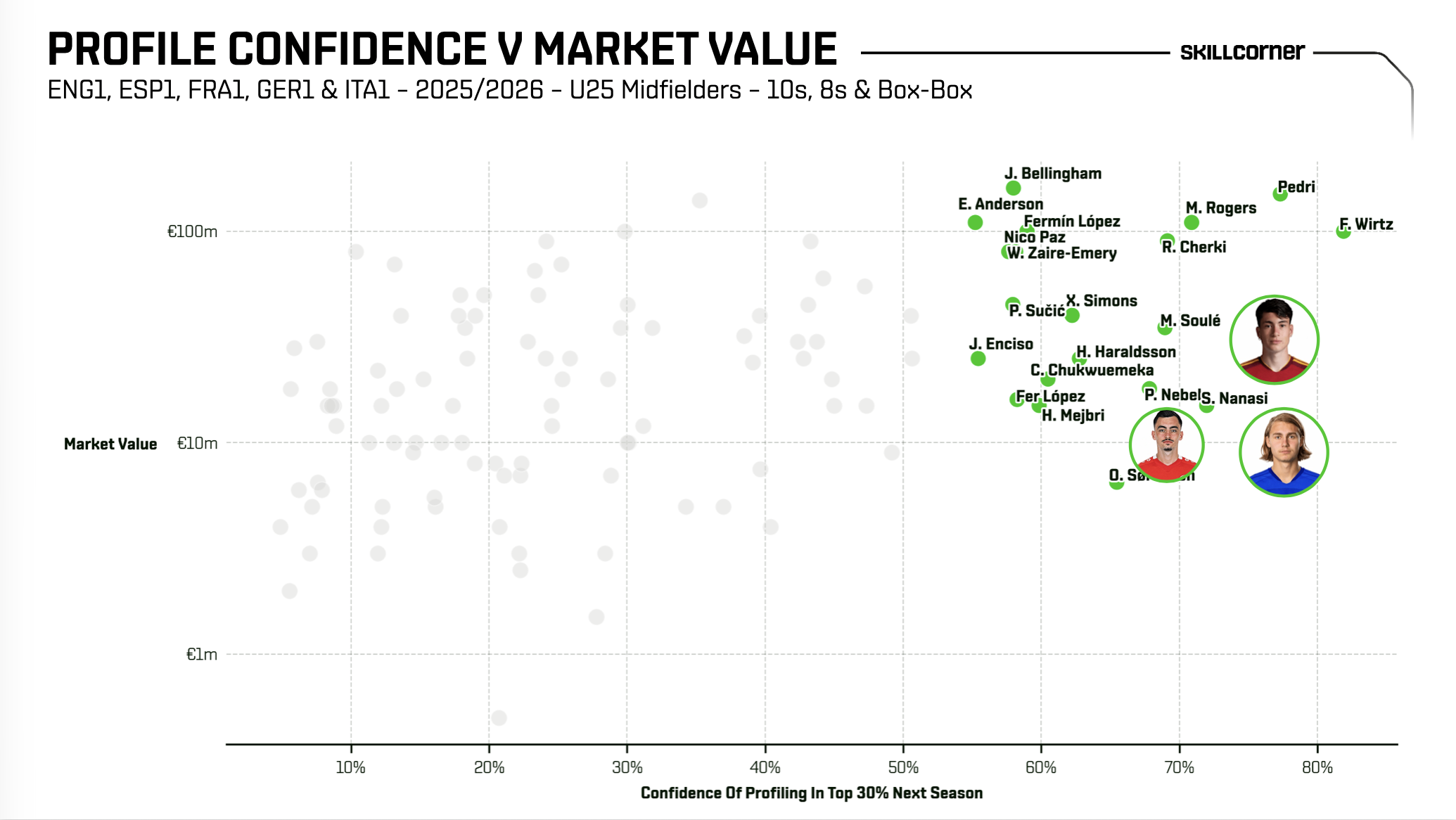
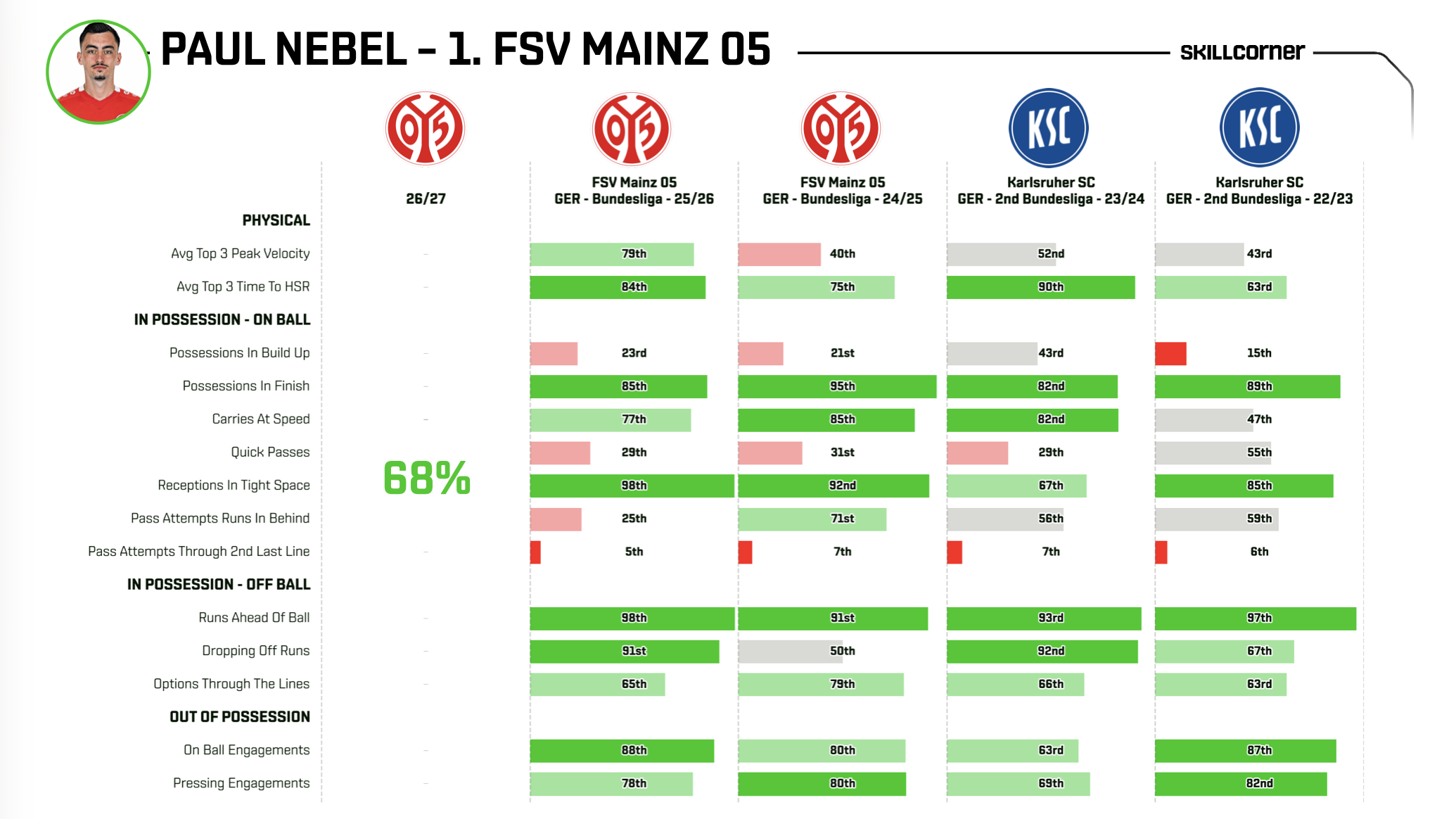
Paul Nebel at Mainz is a prime example. Tracking his metrics over two seasons in the 2. Bundesliga and a couple in the Bundesliga reveals a player with consistently high press-resistance, off-ball movement, and work rate. Looking at his trajectory over the last four years, we can predict with reasonable confidence that, barring major external factors like a severe injury, he will replicate similar numbers.
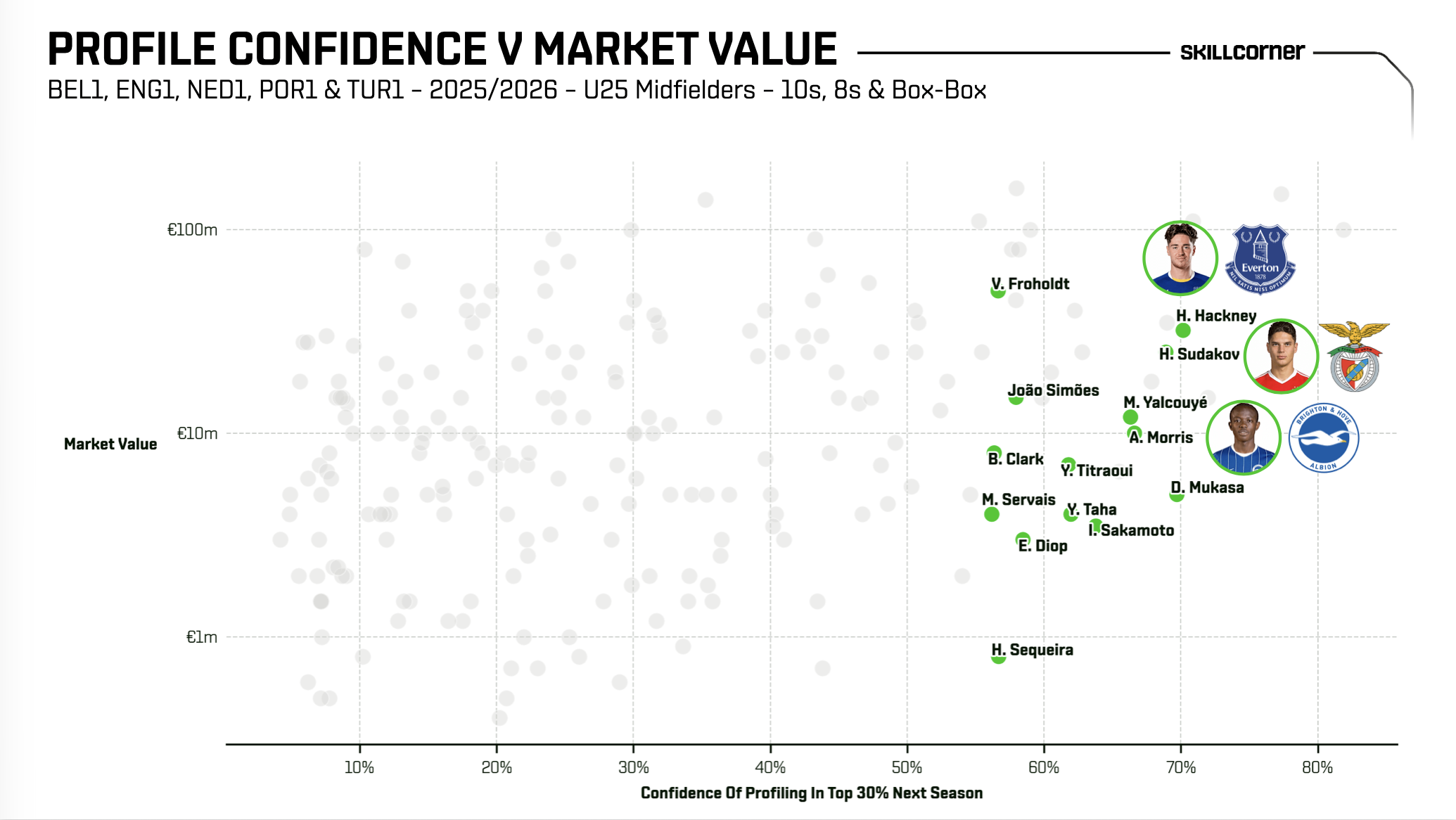
Expanding the search at scale to include leagues outside the Big Five alongside the Premier League uncovers additional profiles whose valuations haven't yet exploded, such as Victor Froholdt, Heorhiy Sudakov, and João Simões.
Going back to the youth ranks
Divine Mukasa, also featured in the chart, brings us to the final frontier of spotting talent early with multi-season scouting: tracking them through the academy ranks. The Manchester City midfielder, currently on loan at West Ham, made his professional debut in September 2025, but our historical data allows us to trace his progression right from his youth days.
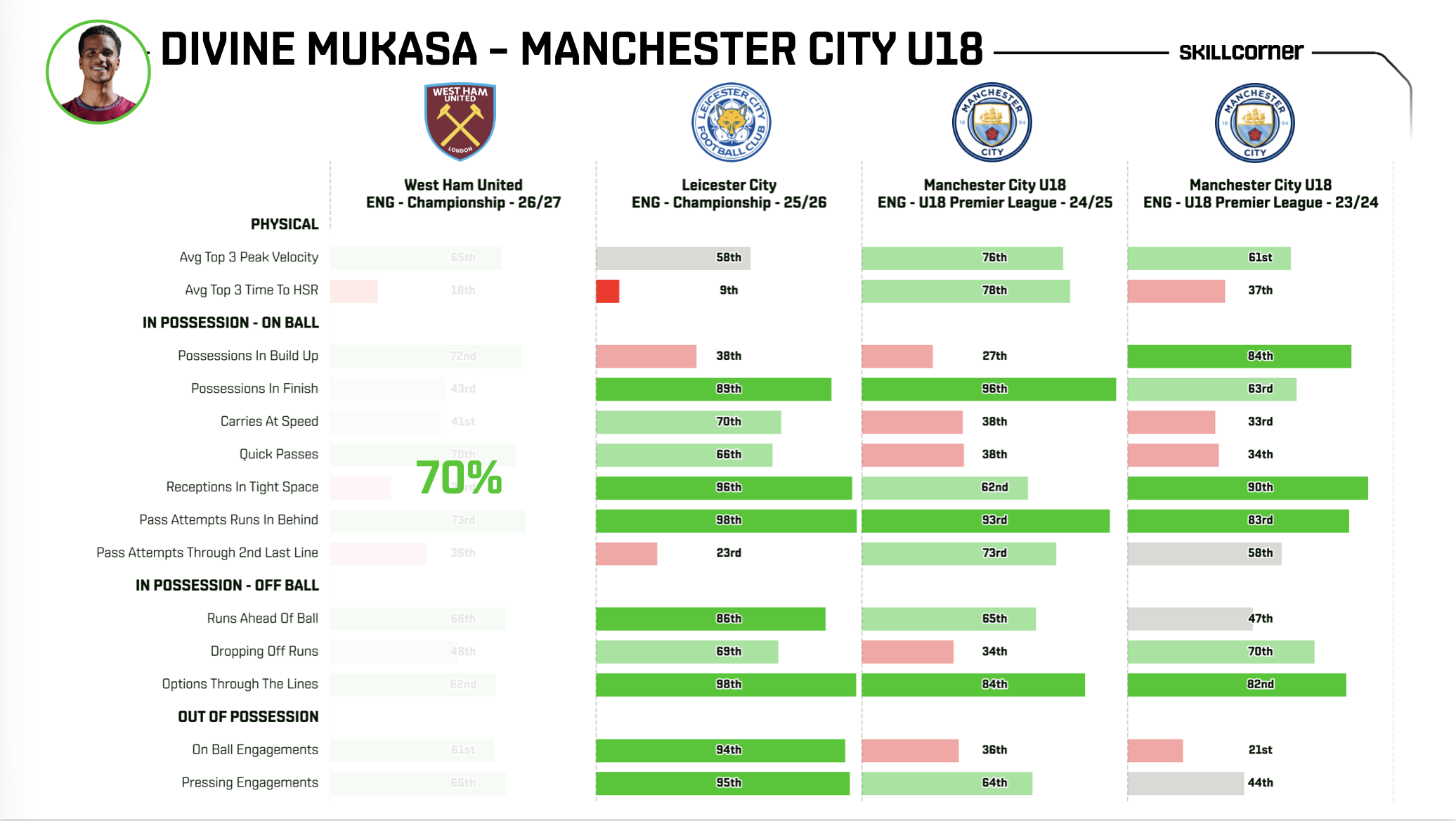
His metrics in the U18 Premier League were already highlighting a player with strong physical capacity, line-breaking passing, tight-space control, and off-ball movement. By tracking these metrics across consecutive seasons, from academy football through to the professional game, we can get a clearer picture of his profile.
Based on the available data, Mukasa demonstrates a repeatable level of performance that holds up regardless of team style, league context, or other external factors. His impressive start to the season in the Championship has, so far, reinforced that signal.
Key takeaways
While no perfect model exists to predict how a new signing will perform, our historical data highlights key indicators that are well worth considering before making a major financial investment in a player.
Be wary of single-season hype: A single strong season carries low statistical confidence (44%) and high variation due to league context and team style, as well as external factors.
Understand the cost-confidence trade-off: Weigh how much you are paying against how much you were able to observe the player throughout time. The more consecutive strong seasons they rack up, the higher the probability they will repeat those indices – but their cost goes hand in hand with that consistency.
Consider early low-cost bets: Investing early in a player with a shorter track record can still make strategic sense, provided you avoid overpaying. Spreading risk across multiple low-cost prospects, rather than paying a premium on a single target, is a well-known blueprint for clubs with tighter budgets, and it can take only one or two successful developments for this strategy to pay off.

Get in touch with our team today to learn how SkillCorner data can help your club navigate the market and spot elite talent early.
%20(1).webp)
.webp)